


Traveller Stories
The Mystery Box: A Journey Beyond Asmat
Warwick Barnes · 3 November 2026
A warehouse in Agats, a three-year wait, and the arrival of a collection that carried the memories of a remarkable journey.
Part 3 of 3 · Papua, 1990: A Journey Remembered
By Warwick Barnes
Three years passed before my share of the artefacts collected during our Asmat journey finally reached me in Australia. Their arrival remains the paramount memory of the trip’s long aftermath.
I came to think of the consignment as the Mystery Box. Its journey involved ships, an Indonesian Air Force flight, a commercial airline, and a chain of people whose efforts eventually brought it home.
The Warehouse in Agats
All of us were collectors. I remember Mike buying shields in Senggo and the three of us sorting through a storeroom in Agats with Irham.
Gat gave us a room with three beds in his warehouse. Each evening, he supplied some of the local visitors with warm Bintangs while they suggested villages of origin for our artefacts. We met his two young sons and showered in rainwater as it poured from the warehouse roof.
The warehouse became part of the story of the collection itself. We had agreed on the transfer of our items, but Gat’s reluctance to carry it out remained unexplained.
Irham continued working to resolve the situation. Ali, the policeman who had introduced us to his family and given us carved spears, eventually helped him secure the release of the artefacts from Gat’s warehouse.
Three Years of Waiting
The route the collection eventually took was extraordinary. From Agats, it travelled by ship to Merauke. The Indonesian Air Force carried it onward to Surabaya, after which it went by sea to Ujung Pandang.
From there, a commercial airline flight carried it to Seattle in the United States. My portion was separated and sent by air to Avalon Beach, Australia.
Its arrival happened to coincide with a business visit by John Vynne. The two events were independent, another coincidence in a journey that had already brought several unexpected connections.
After three years of waiting, the collection had finally arrived. The people and places associated with it were still clear in my mind: the warehouse, the evenings discussing the carvings, and Irham’s efforts to bring the matter to a conclusion.
Asmat in Memory and on the Page
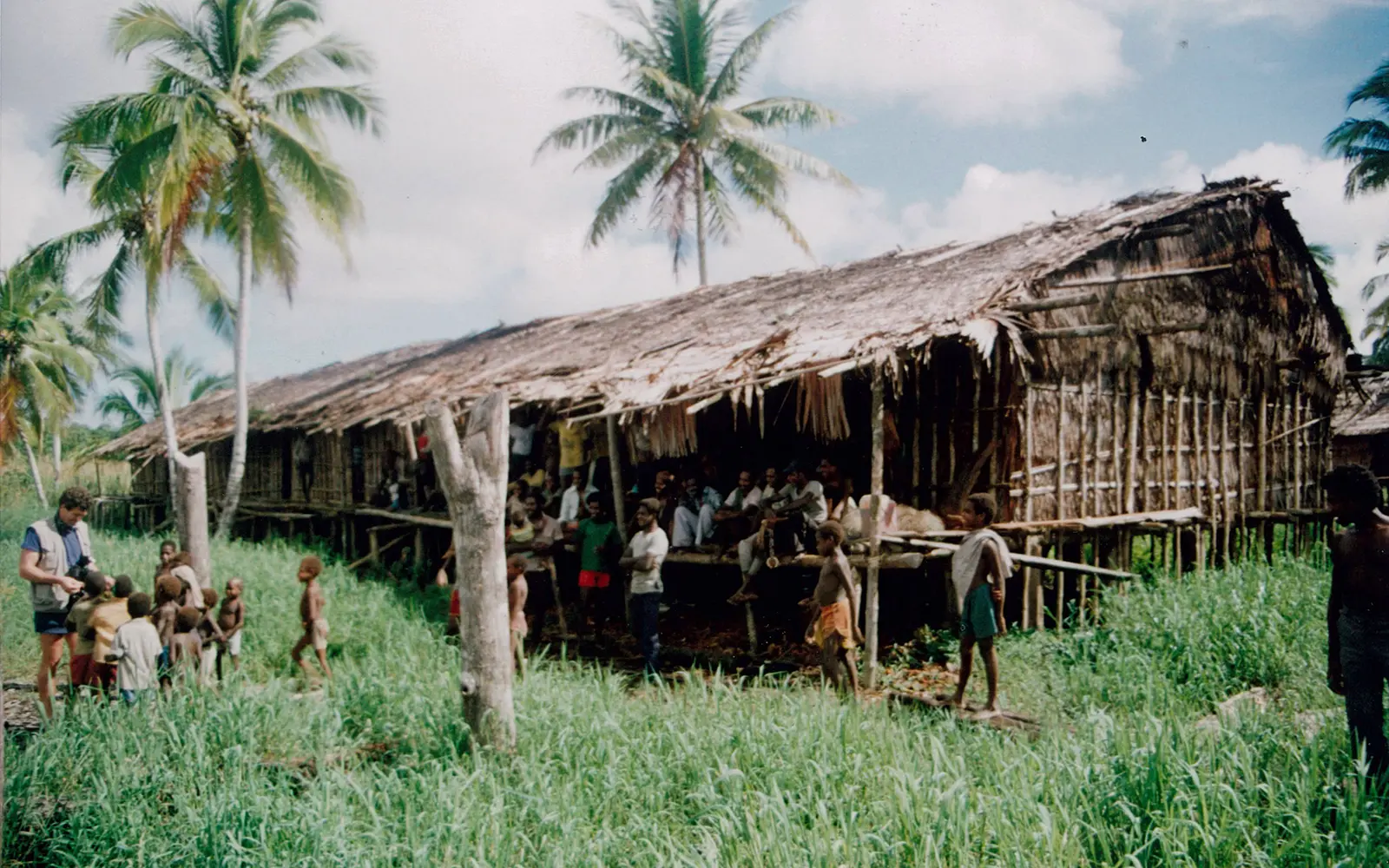
My fascination with the Asmat swamp continued long after I returned home. Over the years, I sought out books for my own interest, looking for connections with the places and people I remembered.
Asmat Images, by Tobias Schneebaum, included a 1979 photograph of a tree house at Tajan, east of Woowi. Asmat Art: Woodcarvings of Southwest New Guinea, edited by Dirk Smidt, contained an overhead photograph of a tree house taken in 1990. These images brought me back to our own encounter with the families living above the ground.
Between the Tides, by David Pickell with photographs by Kal Muller, offered stories and images of the Kamoro. Although it contained no tree-house photographs, I found much to enjoy in its account of another part of New Guinea.
Mark Shand’s Skulduggery brought more recognisable places into view. He and his companions had travelled by dugout canoe on the Brazza River and visited Warse and Senggo. His account also described the difficulties of fitting passengers and a collection of spears and shields within the weight limit of a Cessna leaving Ewer.
I did not always care for his descriptions of local people, but the parallels with our journey were striking. He even wrote of meeting a sister whom I believed to be Sister Consilia, although he recorded her name differently.
Later, Carl Hoffman’s Savage Harvest returned to the question of Michael Rockefeller’s disappearance. That was a subject I encountered through reading, separate from the events I had witnessed during our own trip.
One passage brought me straight back to collecting. Hoffman quoted Rockefeller’s field notes describing the purchase of a spear, after which more spears appeared from the houses around him. I was reminded of Mike buying shields in Senggo, and of the three of us with Irham, sorting through the storeroom in Agats.
End of the series: Papua, 1990: A Journey Remembered.