


Culture
Into Indonesia’s Last Living Frontiers: Beyond the Familiar World
Pacébo · 15 April 2026
Beyond Indonesia’s celebrated beaches and familiar destinations lies another extraordinary world — where ancestral traditions continue to shape everyday life, ancient landscapes preserve humanity’s earliest expressions, and remote forests, rivers, mountains, and seas reveal the remarkable diversity of the Indonesian archipelago.
There is an Indonesia that the world knows well.
An Indonesia of tropical beaches, elegant resorts, ancient temples, and spectacular island sunsets. A place celebrated for its natural beauty, warm hospitality, and extraordinary variety of landscapes.
But beyond these familiar images lies another Indonesia.
One that reveals itself more slowly.
In the mist-covered highlands of Sulawesi, ancestral houses continue to connect families with generations of memory. Deep within the forests of Papua, rivers and trails lead to communities whose knowledge of the natural world has developed over centuries. Across Kalimantan, waterways remain essential routes through vast tropical forests. Beneath the seas of eastern Indonesia, extraordinary marine ecosystems connect islands, reefs, and coastal communities.
These places are not simply remote destinations.
They are living cultural landscapes, shaped by the relationship between people, nature, history, and inherited knowledge.
They remind us that travel can be something far more meaningful than movement between beautiful places.
It can become an encounter with different ways of understanding the world.
At Pacébo, we call these places Indonesia’s Last Living Frontiers.
Not because they exist outside the modern world, nor because their people belong to a distant past.
But because they offer opportunities to explore cultural and natural worlds that remain deeply distinctive, where meaningful encounters demand curiosity, patience, sensitivity, and respect.
The frontier is not simply a distant place on a map. It is the moment when travel takes us beyond what we already understand.
Beyond the Familiar: Discovering Another Indonesia
Indonesia is one of the most culturally and geographically diverse countries on Earth.
Thousands of islands stretch across the equator, connecting volcanic mountains, tropical forests, fertile valleys, coral reefs, and maritime communities.
Within this vast archipelago, different histories and environments have shaped extraordinary ways of life.
For generations, communities have developed relationships with the landscapes around them.
Mountains have influenced settlement and agriculture. Rivers have connected otherwise distant villages. Forests have provided food, materials, medicine, and cultural knowledge. The sea has supported trade, migration, craftsmanship, and traditions of navigation.
These relationships remain visible today.
They can be found in the architecture of an ancestral house, in the knowledge of a forest guide, in the construction of a traditional wooden vessel, or in the responsibilities families continue to honour toward those who came before them.
Yet understanding these places requires more than visiting their most recognisable attractions.
A photograph can capture an extraordinary building without explaining its meaning.
A ceremony can appear spectacular without revealing the family relationships behind it.
A rainforest may look untouched to an unfamiliar traveller, even though its paths, resources, and landmarks have been known to local communities for generations.
The greatest value of cultural travel lies in discovering what exists beyond the first impression.
It begins with listening.
With asking questions.
With recognising that the people who inhabit these landscapes understand them in ways that visitors may only gradually begin to appreciate.
Toraja: Where the Ancestors Remain Part of Everyday Life
High in the mountains of South Sulawesi, Toraja offers one of Indonesia’s most compelling examples of cultural continuity.
Traditional tongkonan houses rise above valleys and cultivated terraces, their distinctive sweeping roofs creating silhouettes unlike almost any other architecture in the archipelago.
Ancient burial sites occupy limestone cliffs. Wooden ancestral effigies, known as tau-tau, stand in certain burial landscapes, while ceremonial gatherings bring extended families together to honour the memory of those who have died.
Yet the true significance of Toraja extends far beyond its remarkable visual heritage.
It lies in the enduring relationship between family, ancestry, land, and responsibility.
Long before Christianity became widespread in the highlands, many aspects of Torajan life were shaped by an ancestral belief system known as Aluk To Dolo, often translated as the Way of the Ancestors.
This worldview traditionally connected human life with agriculture, social relationships, ceremonial obligations, the natural world, and the spiritual realm.
The tongkonan was never simply a house.
It represented family origins, lineage, belonging, and relationships extending across generations.
Even today, Torajans living far from their ancestral homeland may maintain important connections with the houses and communities from which their families originated.
A person may work in Jakarta, Makassar, or overseas while continuing to recognise obligations associated with their ancestral house.
Major family events may bring relatives home after years of separation.
Traditional ceremonies remain important expressions of remembrance, kinship, and collective responsibility.
This is not a society suspended in the past.
Contemporary Toraja is shaped by modern education, migration, Christianity, technology, and changing social expectations.
Yet ancestral memory continues to influence family life.
Perhaps this is what makes Toraja so extraordinary.
Its traditions have not survived simply because people wish to preserve something old.
They continue because, for many families, they still carry meaning.
For travellers, the most rewarding experience is not simply photographing a tongkonan or visiting an ancient burial site.
It is understanding the relationships that give these places their significance.
Our Toraja — Ancestors, Megaliths & Highland Life private journey introduces these cultural landscapes through traditional villages, ancestral houses, burial sites, and the beautiful mountain scenery of South Sulawesi.
In Toraja, heritage is not merely something people inherit. It is something they continue to carry.
Maros-Pangkep: Where Humanity Left Its Stories on Stone
The cultural frontiers of Sulawesi reach far deeper into human history.
Beyond Makassar, the limestone landscapes of Maros-Pangkep contain caves preserving some of the world's most remarkable prehistoric artworks.
Within these ancient rock shelters, traces of human creativity reach back tens of thousands of years.
Painted animals, hand stencils, and other forms of early visual expression reveal that the human desire to create images and communicate meaning existed long before written language.
These artworks invite us to imagine people who lived in landscapes very different from the world we know today, yet who shared something profoundly familiar.
The impulse to observe.
To represent.
To remember.
To leave a mark.
The significance of these caves extends far beyond archaeology.
They remind us that storytelling is not a modern invention.
Long before books, photography, or digital communication, human beings were already using images to express their experiences and relationships with the world.
Standing before an ancient painted surface changes the meaning of distance.
The physical journey to the cave may be relatively short.
But the journey through time is immense.
Here, Indonesia reveals another kind of frontier.
Not a place beyond the reach of modern civilisation, but a place where we encounter some of the deepest roots of human imagination.
And it reminds us that the history of the Indonesian archipelago belongs to a much broader human story.
Bada Valley: The Silent Mystery of Sulawesi’s Megaliths
Further into the interior of Sulawesi lies another extraordinary cultural landscape.
In the Bada Valley, ancient stone monuments stand among agricultural fields, villages, and mountains.
Some are carved into humanlike figures, while others take different forms whose original purposes and meanings remain subjects of archaeological research.
The monuments are striking not only because of their appearance, but because of the questions they leave unanswered.
Who created them?
What roles did they play within the societies that produced them?
How did the people of these valleys understand their relationship with the land, their ancestors, and the unseen world?
Not every question has a clear answer.
And that uncertainty is part of the experience.
A visit to Bada Valley offers a reminder that cultural travel does not always lead to complete explanations.
Sometimes, it leads to a deeper appreciation of what remains unknown.
The megaliths stand within a contemporary landscape of villages, cultivated land, and people carrying on with their daily lives.
They are not isolated museum objects.
They belong to a place where human history exists alongside the present.
For travellers drawn to Sulawesi’s cultural heritage, Pacébo’s Toraja & Bada Valley — Highlands, Megaliths & Living Traditions connects ancestral traditions, mountain landscapes, megalithic sites, and the lake communities of the island’s interior.
The journey reflects something essential about Indonesia.
Its history is not contained within one monument, one community, or one period of time.
It exists in layers, waiting to be understood.
Papua: Where the Journey Becomes Part of the Experience
In Papua, the meaning of distance changes.
Mountains rise dramatically above cultivated valleys. Vast forests extend towards broad rivers, and journeys between communities may require combinations of aircraft, boats, vehicles, and walking trails.
Travel here demands a different rhythm.
Schedules must accommodate weather, local conditions, and the practical realities of reaching remote places.
The landscape cannot always be experienced according to the predictable timetable of a conventional holiday.
Yet these challenges are inseparable from the extraordinary character of the journey.
Papua is home to an immense diversity of communities, languages, cultural traditions, and natural environments.
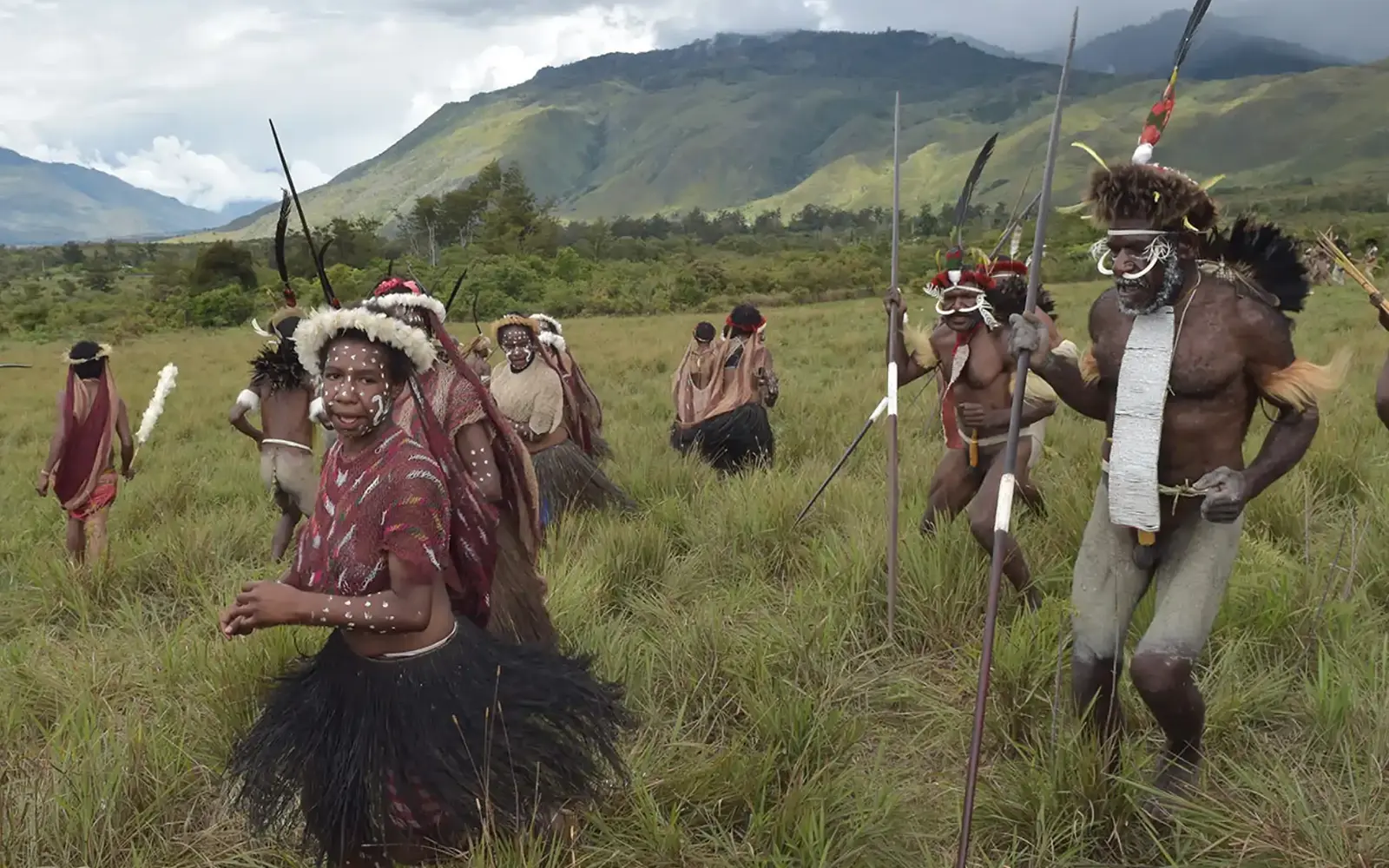
From the cultivated highlands of the Baliem Valley to the rainforests of Korowai territory and the river communities of Asmat, each region reveals a different relationship between people and place.
The people who live here are not representatives of a world frozen in time.
They are members of contemporary societies whose inherited traditions continue to evolve alongside modern education, religion, transport, technology, and changing economic realities.
To understand Papua is to recognise both its cultural continuity and its transformation.
The Baliem Valley: Culture Among the Mountains
In the central highlands, the Baliem Valley reveals a landscape shaped by generations of settlement and agriculture.
Traditional honai houses, sweet potato gardens, mountain villages, and winding pathways remain part of the region’s cultural identity.
Communities including the Hubula, commonly known to many outsiders as Dani, as well as other highland peoples, maintain distinctive histories and traditions.
Each year, the Baliem Valley Cultural Festival provides an opportunity for participating communities to celebrate aspects of their heritage through dance, music, traditional attire, and historical performances.
But the valley’s cultural richness does not begin or end with the festival.
It can be found in daily agricultural work, family relationships, local markets, and the knowledge passed between generations.
A meaningful journey into the highlands leaves room for these quieter experiences.
The opportunity to walk through cultivated valleys, meet local hosts, and understand how communities relate to their environment can be as memorable as the most spectacular ceremony.
Korowai: The Forest as Home and Knowledge
Far to the south, the forests associated with the Korowai offer another perspective on the relationship between people and nature.
The Korowai are widely known for their extraordinary elevated houses, sometimes built high among rainforest trees.
Yet the cultural importance of these structures extends beyond their height or unusual appearance.
They reflect knowledge of timber, rattan, palm materials, construction methods, and local environmental conditions.
The forest itself provides food, building materials, routes of movement, and resources whose uses are understood through generations of experience.
Sago palms are particularly important within traditional food systems.
The processing of sago requires considerable skill, while knowledge of forest plants, waterways, and wildlife forms part of a broader relationship with the surrounding environment.
To an unfamiliar visitor, the rainforest may appear to be an endless expanse of vegetation.
To those who know it, the landscape contains paths, resources, memories, and signs that are not immediately visible to outsiders.
This is why the most meaningful encounter with Korowai territory is not simply the sight of a tree house.
It is an appreciation of the knowledge that makes life in the forest possible.
Asmat: Where Wood, Water, and Ancestral Memory Meet
The great river systems of southern Papua reveal yet another cultural world.
In the Asmat region, waterways connect settlements across extensive lowland forests and wetlands.
Boats remain essential to movement, communication, and daily life.
The Asmat are internationally recognised for extraordinary woodcarving traditions, in which artistic expression has long been connected to ancestral memory, social relationships, and ceremonial life.
Carved figures, shields, and other wooden works reveal a remarkable artistic heritage.
Yet the significance of Asmat art should not be reduced to its appearance.
These objects emerge from particular cultural contexts, and their meanings may vary according to the community, artist, and purpose.
Travellers who encounter these traditions through knowledgeable local interpretation gain a deeper appreciation of the relationships between art, identity, and remembrance.
For those seeking to explore these contrasting cultural landscapes in one journey, our Epic Papua — Highlands, Ancestors & Living Frontiers expedition brings together the Baliem Valley, Korowai forest territory, and the river cultures of Asmat.
It is an exploration shaped not simply by distance, but by the extraordinary diversity of the people and environments encountered along the way.
In Papua, the most remarkable discovery is often not how far we have travelled, but how much there remains to understand.
Kalimantan: Rivers, Rainforests, and the Memory of the Land
Across Kalimantan, the Indonesian part of Borneo, another relationship between people and landscape unfolds.
Here, vast tropical forests are connected by rivers that have served as routes of movement, communication, and trade for generations.
In many areas, the river is more than a geographical feature.
It is a road.
A source of livelihood.
A connection between families and settlements.
A defining element of the surrounding environment.
Among the diverse Dayak peoples of Borneo, cultural traditions reflect long histories of adaptation to forest and river landscapes.
Different communities maintain their own languages, ceremonies, architecture, craftsmanship, and understandings of their ancestral heritage.
These traditions are far from uniform.
The term Dayak encompasses many distinct cultural groups whose histories and contemporary lives cannot be reduced to a single identity.
But across these diverse communities, relationships with land, rivers, family, and inherited knowledge remain important themes.
In Central Kalimantan, the waterways surrounding Tanjung Puting National Park reveal another dimension of this extraordinary island.
Travelling aboard a traditional wooden riverboat, known as a klotok, visitors move slowly through forested waterways where wildlife and vegetation create a constantly changing landscape.
Orangutans inhabit the forests, while proboscis monkeys, birds, and other wildlife may be observed along the riverbanks.
The experience is not simply about encountering remarkable animals.
It is about learning to appreciate the forest as a complex living ecosystem.
The sounds of insects after sunset.
The reflection of trees on dark water.
The sudden movement of a monkey through the canopy.
The quiet rhythm of a boat travelling along the river.
These moments remind us that nature is not simply scenery surrounding an itinerary.
It is a living system that demands attention and care.
Our Tanjung Puting — Orangutans, Rainforests & River Worlds journey explores this landscape aboard a private klotok, combining forest experiences, wildlife observation, and time to appreciate the atmosphere of Kalimantan’s waterways.
Here, the greatest luxury may simply be the opportunity to slow down enough to notice what surrounds us.
The Maritime Frontier: Where Indonesia Meets the Sea
Indonesia’s cultural frontiers do not end at the edge of the forest or the summit of a mountain.
They continue across the sea.
For centuries, maritime knowledge has shaped trade, migration, craftsmanship, and connections between the islands of the archipelago.
In South Sulawesi, the Bugis and Makassar maritime heritage reflects a long relationship with navigation, shipbuilding, and the movement of people and goods across Indonesian waters.
The traditional phinisi is among the most recognisable expressions of this seafaring heritage.
Its construction reflects specialised woodworking skills, inherited knowledge, and an understanding of how vessels must respond to wind, waves, and the demands of maritime travel.
In the shipbuilding communities of South Sulawesi, the creation of a wooden vessel involves far more than assembling timber.
It requires experience, cooperation, and skills developed through generations of craftsmanship.
The finished vessel represents both a practical achievement and a continuation of maritime knowledge.
The sea has never been simply a barrier separating Indonesian islands.
It has also been a route connecting them.
And this maritime identity remains an essential part of understanding the Indonesian archipelago.
Beneath the Surface: Indonesia’s Living Marine Frontiers
Beyond its coastal communities, Indonesia reveals another extraordinary world beneath the surface of the sea.
Within the Coral Triangle, the waters of eastern Indonesia support exceptionally diverse coral reefs and marine ecosystems.
From the steep reef walls of Bunaken in North Sulawesi to the limestone islands and coral gardens of Raja Ampat, these environments reveal the remarkable richness of tropical marine life.
Turtles move along coral walls.
Reef fish gather above intricate underwater structures.
Tiny marine creatures inhabit volcanic sands and reef habitats.
Currents carry nutrients through complex underwater environments, while mangroves and coastal ecosystems contribute to broader ecological connections.
For divers and snorkellers, the experience can be breathtaking.
But the significance of these marine landscapes extends beyond their visual beauty.
Coral reefs are living ecosystems, vulnerable to environmental pressures, careless human activity, and broader changes affecting the oceans.
To enter these waters responsibly is to recognise that their beauty is not an unlimited resource.
Respectful diving and snorkelling require careful movement, appropriate buoyancy, and an understanding of how to observe marine life without disturbing it.
In North Sulawesi, our Bunaken & Lembeh — Coral Walls, Turtles & Macro Worlds journey explores two contrasting underwater environments, from Bunaken’s dramatic reef walls to the extraordinary smaller marine life of Lembeh Strait.
Further east, our Raja Ampat — Reefs, Lagoons & Island Worlds private journey introduces the island landscapes and marine ecosystems of one of Indonesia’s most celebrated regions.
These places remind us that the meaning of exploration changes when we understand the responsibility that comes with it.
The deeper we enter a natural environment, the more important it becomes to protect what makes it extraordinary.
A Different Understanding of Exploration
For much of history, exploration has been described through the language of discovery and conquest.
Distant lands were presented as places waiting to be reached, mapped, and understood by outsiders.
But meaningful travel in the modern world requires a different perspective.
The places we visit are rarely unknown to the people who live there.
A rainforest described as unexplored may contain generations of local knowledge.
A mountain valley considered remote may be the centre of someone’s family history.
An ancestral village that appears extraordinary to a visitor may simply be home to the people who belong to it.
This distinction matters.
An expedition should not be about claiming to discover what others have always known.
It should be about entering unfamiliar environments with humility and a willingness to learn.
For Pacébo, exploration means travelling with cultural intelligence.
Knowing when to ask questions and when to listen.
When to photograph and when to lower the camera.
When to continue and when to allow time for the unexpected.
When an encounter is appropriate and when a private moment should remain private.
A meaningful journey is not defined by the number of places visited or by how far a traveller has ventured from familiar comforts.
It is defined by the quality of understanding gained along the way.
The purpose of exploration is not to conquer distance. It is to approach unfamiliar worlds with knowledge, curiosity, and respect.
The True Meaning of Luxury in Remote Indonesia
Luxury means different things in different places.
In an established resort destination, it may be expressed through beautiful accommodation, refined dining, elegant design, and highly personalised service.
In the highlands, forests, and rivers of remote Indonesia, the meaning can be different.
An expedition through Papua may involve long boat journeys, basic accommodation, challenging forest trails, and conditions that require flexibility.
A journey into Kalimantan’s rainforest may unfold aboard a simple wooden boat rather than inside a large hotel.
A cultural visit in Toraja may depend on the circumstances of a family's private ceremony rather than a fixed tourism schedule.
These experiences cannot always be arranged to meet the expectations of conventional luxury travel.
Yet they can offer something exceptionally valuable.
Time in places that few travellers experience with depth.
Access to specialist local knowledge.
Carefully organised logistics in challenging environments.
Thoughtful cultural introductions.
The opportunity to travel privately, at a pace suited to individual interests.
And the confidence that important practical arrangements have received professional attention.
This is a different understanding of premium travel.
It does not confuse comfort with extravagance.
Nor does it romanticise the challenges of remote regions.
Instead, it recognises that the value of a journey lies in the care with which it is designed and the understanding it makes possible.
Sometimes, the most extraordinary experience is not found in the most elaborate accommodation.
It is found in a conversation beneath an ancestral house.
In the quiet of a forest river.
In the knowledge shared by a local guide.
Or in the simple privilege of being welcomed into a place with respect.
Responsible Travel: A Privilege That Carries Responsibility
Every journey leaves an impression.
Not only upon the traveller, but also upon the people, communities, and environments that receive visitors.
Tourism can create opportunities for local employment, support services, and cultural exchange.
But when poorly managed, it can also place pressure on communities, environments, and traditions.
This is particularly important in regions where tourism remains relatively limited or where infrastructure is fragile.
A traditional ceremony is not an attraction organised for outsiders.
A village is not a stage.
A rainforest is not empty land.
A coral reef is not an unlimited playground.
Responsible travel begins by recognising these distinctions.
It requires care when choosing how to enter communities, how to photograph people, how to interact with wildlife, and how to use natural resources.
It also requires acknowledging that visitors are guests within places that belong to others.
Local communities must retain agency over the experiences they choose to share.
Cultural traditions should be presented with context rather than simplified into spectacles.
Wildlife encounters should follow appropriate conservation practices.
And itineraries should be designed with realistic expectations about local conditions.
For travellers, this approach creates more meaningful experiences.
For communities and environments, it can contribute to a more considerate form of tourism.
The goal is not to avoid every impact, which is impossible.
It is to make thoughtful decisions that respect the places and people involved.
Pacébo: A Name Rooted in Indonesia’s Cultural Frontiers
The name Pacébo carries three great regions of the Indonesian archipelago within it.
Papua. Celebes. Borneo.
Three different worlds, connected by extraordinary landscapes, diverse cultures, and histories that continue to influence life today.
Papua, with its dramatic highlands, rainforest rivers, and remarkable cultural diversity.
Celebes, the historical name for Sulawesi, with its ancestral traditions, prehistoric landscapes, maritime heritage, and distinctive communities.
Borneo, with its vast rainforests, river systems, wildlife, and cultural histories.
These regions form an important part of the identity behind Pacébo.
But our philosophy extends beyond geography.
We believe that exceptional travel requires more than arranging transportation and accommodation.
It requires local understanding.
Thoughtful preparation.
Respectful relationships.
And the ability to recognise what makes each destination distinctive.
Our journeys are shaped with the support of local guides, drivers, boat crews, village hosts, cultural interpreters, and expedition teams.
Their knowledge is essential.
A map can show the course of a river, but it cannot replace the experience of someone who understands its changing conditions.
An itinerary can identify a traditional village, but it cannot explain every custom or expectation associated with entering it.
A photograph can introduce an extraordinary landscape, but it cannot communicate everything that landscape means to the people who inhabit it.
These are the reasons local expertise matters.
At Pacébo, our approach combines personalised journey design, carefully coordinated logistics, experienced guiding, and an appreciation for the cultural and environmental character of each destination.
Some journeys offer carefully selected hotels and comfortable private transportation.
Others involve simple expedition accommodation, riverboats, or challenging routes into remote areas.
What connects them is our commitment to thoughtful planning and meaningful experiences.
We do not believe that every destination should be made to resemble a luxury resort.
We believe each place should be experienced in a way that respects its character while providing the most appropriate level of comfort, care, and professional support.
For Pacébo, the journey is never simply about reaching a destination. It is about understanding what makes that destination matter.
The Stories Found in Stillness
Some of Indonesia’s most powerful travel memories emerge in moments that would never appear on an ordinary itinerary.
The silence before entering an ancestral house in Toraja.
Morning mist drifting across the cultivated valleys of Papua.
The sound of a wooden boat moving slowly through a Kalimantan river.
A craftsman carefully shaping timber for a traditional vessel.
The brief sight of a tarsier moving through the forest at dusk.
The changing light above limestone islands in Raja Ampat.
A local guide recognising a forest path that seems invisible to an unfamiliar traveller.
Or the quiet conversation that follows a shared meal in a village far from the usual tourist routes.
Such moments cannot always be planned.
They require time and attentiveness.
They ask travellers to set aside the pressure of collecting experiences and to become more present in the places they visit.
Often, the memories that remain longest are not the grandest or most dramatic.
They are the moments when something unfamiliar begins to feel understandable.
When a cultural practice gains context.
When a landscape becomes connected to a human story.
When a conversation reveals a different perspective.
And when a journey changes not only what we have seen, but how we see the world.
An Invitation to Travel Beyond the Familiar
Indonesia’s living frontiers are not simply its most remote destinations.
They are the places where we are invited to encounter the extraordinary diversity of human experience and the natural world.
Some are separated from major cities by mountains, rivers, and forests.
Others are geographically accessible, yet culturally profound.
What connects them is not their distance from civilisation.
It is their ability to reveal something beyond the familiar.
These places are changing, as all living societies and environments do.
Their traditions are not frozen in time.
Their communities are not untouched by the modern world.
Their landscapes are not immune to environmental pressures.
That is why thoughtful exploration matters.
To travel through these regions is a privilege.
To introduce others to them is a responsibility.
And to tell their stories is an opportunity to encourage a different way of travelling.
One guided by curiosity rather than conquest.
By understanding rather than spectacle.
By meaningful encounters rather than hurried consumption.
At Pacébo, this is the kind of travel we believe in.
Journeys that honour the places they enter.
Journeys that appreciate the knowledge of local communities.
Journeys that balance comfort with the realities of the destination.
And journeys that leave travellers with more than beautiful photographs.
If you are ready to explore a different side of Indonesia, begin planning your tailor-made journey with Pacébo, and discover experiences shaped by cultural understanding, local expertise, and thoughtful exploration.
Because the most extraordinary journeys do not always lead to places no one has seen before.
Sometimes, they lead us to see familiar ideas — culture, nature, history, and belonging — in entirely new ways.
This is Indonesia beyond the familiar.
Living. Ancestral. Diverse. Extraordinary.
These are the living frontiers we choose to explore.