


Field Notes
Field Notes from Asmat: Between River, Rain and Carved Memory
Pacébo · 15 May 2026
In the tidal lowlands of southern Papua, rivers replace roads, wood carries ancestral memory, and everyday life unfolds to the rhythm of water and rain. These field notes follow a journey into Asmat — a remarkable cultural landscape where art, identity, and the natural world remain deeply connected.
Some places are remembered through landmarks.
Others remain with us through the smallest details.
The sound of rain falling onto a wooden walkway. The gentle movement of a canoe against a riverbank. The scent of wet timber. Wood shavings gathering beneath the hands of a carver. The distant sound of a boat engine travelling through the mangroves.
Asmat is one of those places.
In the lowlands of southern Papua, the landscape appears to exist somewhere between forest and water. Great rivers wind through wetlands, villages rise above muddy ground, and boats follow waterways that have connected communities for generations.
For outsiders, this world may initially seem difficult to understand.
There are few of the familiar reference points that shape travel elsewhere in Indonesia.
Distances are not always measured by roads. Movement depends on rivers, tides, weather, and the knowledge of people who understand the environment.
Yet it is not simply the remoteness of Asmat that makes the journey unforgettable.
It is the remarkable relationship between its people and their surroundings.
The Asmat are internationally recognised for an extraordinary tradition of woodcarving, in which artistic expression has long been connected to ancestral remembrance, social relationships, and cultural identity.
But the deeper story cannot be understood through sculpture alone.
It is found in the villages, the waterways, the forest, the everyday work of families, and the knowledge passed between generations.
Our journey began with an interest in the celebrated woodcarvings of Asmat.
What remained in our memories was the world that gave those carvings their meaning.
In Asmat, the river carries people, the forest provides, and the hands remember.
Agats: A Town Built Around Water
The first thing we notice in Asmat is not the distance.
It is the water.
Water beneath houses. Water beside walkways. Water carrying boats between settlements. Water rising and falling with the tides, shaping the rhythm of daily life.
In Agats, the administrative centre of Asmat Regency in South Papua, the relationship between land and water feels different from almost anywhere else in Indonesia.
Much of the town is built above swampy ground.
Raised wooden and concrete walkways connect houses, small businesses, offices, schools, and neighbourhoods. Motorcycles travel along elevated paths. Children walk to school. Goods arrive from boats at the riverfront.
There is movement everywhere, but the town follows its own rhythm.
In the morning, boats come and go carrying sacks of rice, boxes, vegetables, fuel, bottled water, construction materials, and countless other essentials.
Small shops begin their day. People greet neighbours as they pass. Motorcycles create familiar vibrations along the boardwalks.
Nearby, someone may be repairing a wooden boat or preparing supplies for a journey into the surrounding waterways.
Then the rain begins.
At first, it may be little more than a passing shower. Soon the walkways darken, reflections appear beneath the buildings, and the air grows heavier with humidity.
Yet daily life continues.
People move beneath umbrellas. Boats remain busy along the waterfront. Children make their way home. Someone carries another delivery across the raised path.
For a visitor arriving for the first time, it takes a moment to adjust.
Then the logic of the place begins to reveal itself.
Agats is not a conventional town built against the surrounding environment.
Its layout and daily activities reflect an enduring need to live with water.
The swamp is not simply an obstacle to overcome.
The river is not merely a scenic feature.
Both are essential elements of the landscape in which the town exists.
And this is the first lesson Asmat offers us.
To understand the place, we must first understand the water.
The River Is the Road
Beyond Agats, the journey continues by boat.
The engine starts, the raised walkways gradually disappear behind us, and the surrounding landscape opens into a vast world of rivers, tributaries, mangroves, muddy banks, and tropical forest.
There are no road signs marking the way.
No asphalt highways connecting every settlement.
No traffic lights guiding the movement of people.
Instead, the waterways provide the connections.
Boats transport families between villages. They carry food, fuel, building materials, traders, teachers, government workers, visitors, and countless other passengers.
For many communities, travelling by river remains an essential part of ordinary life.
What appears geographically isolated to an outsider is connected through a different system.
A geography of water.
Occasionally, another canoe or motorboat approaches from the opposite direction.
A hand is raised.
A greeting is exchanged.
Then the vessel disappears around a bend, and the forest closes once more.
The riverbanks change as we move.
At certain points, thick mangrove roots emerge from the mud. Elsewhere, taller trees rise above the water, their reflections broken by the current.
A small settlement may appear beyond a stretch of vegetation. A narrow canoe rests against the bank. Smoke rises somewhere behind the houses.
Life reveals itself in fragments.
And these fragments gradually become more meaningful than the idea of reaching a destination as quickly as possible.
What a Map Cannot Tell Us
On a map, two villages may appear relatively close together.
On the river, distance becomes something entirely different.
Travel depends on the boat, the weather, the tide, the current, the availability of fuel, and the experience of the people guiding the journey.
A route that appears straightforward may require hours.
A change in water conditions can influence the timing or direction of travel.
Heavy rainfall may make certain journeys more difficult. Lower water levels can affect access to smaller channels, while tidal changes may determine when a boat can pass safely through particular areas.
This is why local knowledge matters so profoundly in Asmat.
An experienced boat operator understands the waterways in ways that no ordinary map can fully communicate.
The appearance of the river may suggest a changing current.
The condition of a muddy bank may determine whether an approach is practical.
The experience of previous journeys helps guide decisions that visitors would struggle to make independently.
In such an environment, professional expedition planning is essential.
But so is flexibility.
Travel cannot always follow a rigid timetable.
And perhaps it should not.
The journey between villages is not empty time separating one attraction from another.
It is part of discovering Asmat itself.
There are moments when little seems to happen.
The engine continues its steady rhythm. The forest moves slowly past. Rain appears in the distance.
A fisherman stands inside a narrow canoe.
A bird crosses the river.
A child waves from a settlement along the bank.
These moments rarely appear in a formal itinerary.
Yet they are often the details that make the journey unforgettable.
Arriving in an Asmat Village: The Importance of Respect
Arriving in an Asmat village is very different from entering a conventional tourist attraction.
There may be no formal entrance, reception area, or prepared programme waiting for visitors.
We are entering a place where people live.
Someone may be preparing food.
A family may be working.
Children may be playing.
A canoe may need repairing.
A carver may be occupied with an unfinished piece of wood.
Or the community may simply have other priorities that day.
The first responsibility of a visitor is therefore not to begin taking photographs.
It is to arrive appropriately.
To greet.
To listen.
To understand who is welcoming us.
And to allow the local guide or community representative to establish introductions before the encounter begins.
These steps may seem simple, but they fundamentally change the character of a visit.
A village is not an exhibition arranged for outsiders.
A family is not obliged to perform its traditions.
A cultural practice does not become publicly accessible merely because a traveller is interested in seeing it.
Meaningful encounters develop through respect, communication, and local agreement.
A knowledgeable local guide plays an essential role in this process.
They can help visitors understand expectations, communicate with hosts, and recognise when photography or participation is appropriate.
Sometimes, the most valuable experience is simply sitting together, observing daily life, and listening to the explanations that hosts choose to share.
We may arrive hoping to discover a remarkable tradition.
But we should also be prepared to encounter something more ordinary.
A conversation.
A shared moment.
A glimpse of family life.
A quiet afternoon beside the river.
These experiences can communicate more about a community than any performance arranged for visitors.
Cultural travel becomes meaningful when we stop treating access as an entitlement and begin recognising it as a privilege.
Wood, Water, and the Language of Asmat Art
Wood is everywhere in Asmat.
It forms houses and walkways.
It becomes canoes and paddles.
It is used for tools, everyday objects, and architectural structures.
And, through the hands of skilled artists, it becomes one of Indonesia's most extraordinary forms of cultural expression.
Asmat woodcarving has attracted international attention for decades.
Museums and private collections around the world preserve examples of elaborately carved shields, figures, paddles, drums, and ceremonial sculptures associated with different Asmat communities.
Their forms can be striking.
Human figures emerge from timber. Repeated patterns create rhythm. Bold shapes, carved surfaces, and traditional pigments bring distinctive visual languages to life.
Yet approaching these objects only as works of art can leave much of their significance unexplained.
An object may carry references to family history, ancestral relationships, social identity, ceremonial responsibilities, or the knowledge of previous generations.
Its meaning depends on the community, the artist, the context, and the purpose for which it was created.
Not every carving is ceremonial.
Some are made for everyday use.
Others are created for contemporary artistic expression or sale.
And certain forms belong to specific traditions that should not be assumed to exist identically throughout the Asmat region.
This diversity matters.
The people of Asmat do not share one single, unchanging artistic practice.
Their traditions have developed across different communities and continue to evolve.
To understand the carvings, we must therefore look beyond their appearance.
We must ask where they come from.
Who created them.
What they were intended to express.
And how their meaning is understood by the people connected to them.
Bisj Poles: Remembering the Ancestors Through Wood
Among the most remarkable expressions of Asmat carving are the monumental ancestor poles commonly known as bisj or bis.
Associated with particular communities and ceremonial traditions in the Asmat region, these tall wooden sculptures have historically been created to commemorate deceased individuals.
Human figures may appear arranged vertically along the pole, representing specific people whose memory is being honoured.
Their forms can be extraordinarily complex.
A single tree may be transformed into a towering memorial sculpture, its carved figures and projecting elements reflecting highly specialised knowledge.
In traditional contexts, bisj poles were connected to ceremonies concerned with ancestry, remembrance, spiritual relationships, and restoring balance within the community.
They belonged to a wider ceremonial world whose meanings cannot be fully understood through appearance alone.
Historical Asmat traditions also included practices associated with conflict and the obligations understood to arise from death. Such elements require careful historical interpretation rather than sensational presentation.
For modern visitors, what matters is recognising that these sculptures were never simply decorative objects.
They were created within particular relationships between the living and the dead.
The pole carried names.
Memory.
Loss.
And the responsibilities of remembrance.
Museum collections now preserve important examples of these works, making them accessible to audiences far beyond Papua.
Yet their original meaning belongs to the cultural setting from which they emerged.
A sculpture standing inside an international museum may be admired for its artistic achievement.
But in Asmat, its story begins with people, community, memory, and the forest from which the wood was taken.
Not every village produces bisj poles today, and contemporary ceremonial practices differ across communities.
Understanding this variation is essential to appreciating Asmat culture as a living, changing heritage.
In Asmat, carved wood can become a way of remembering those whose lives continue to matter.
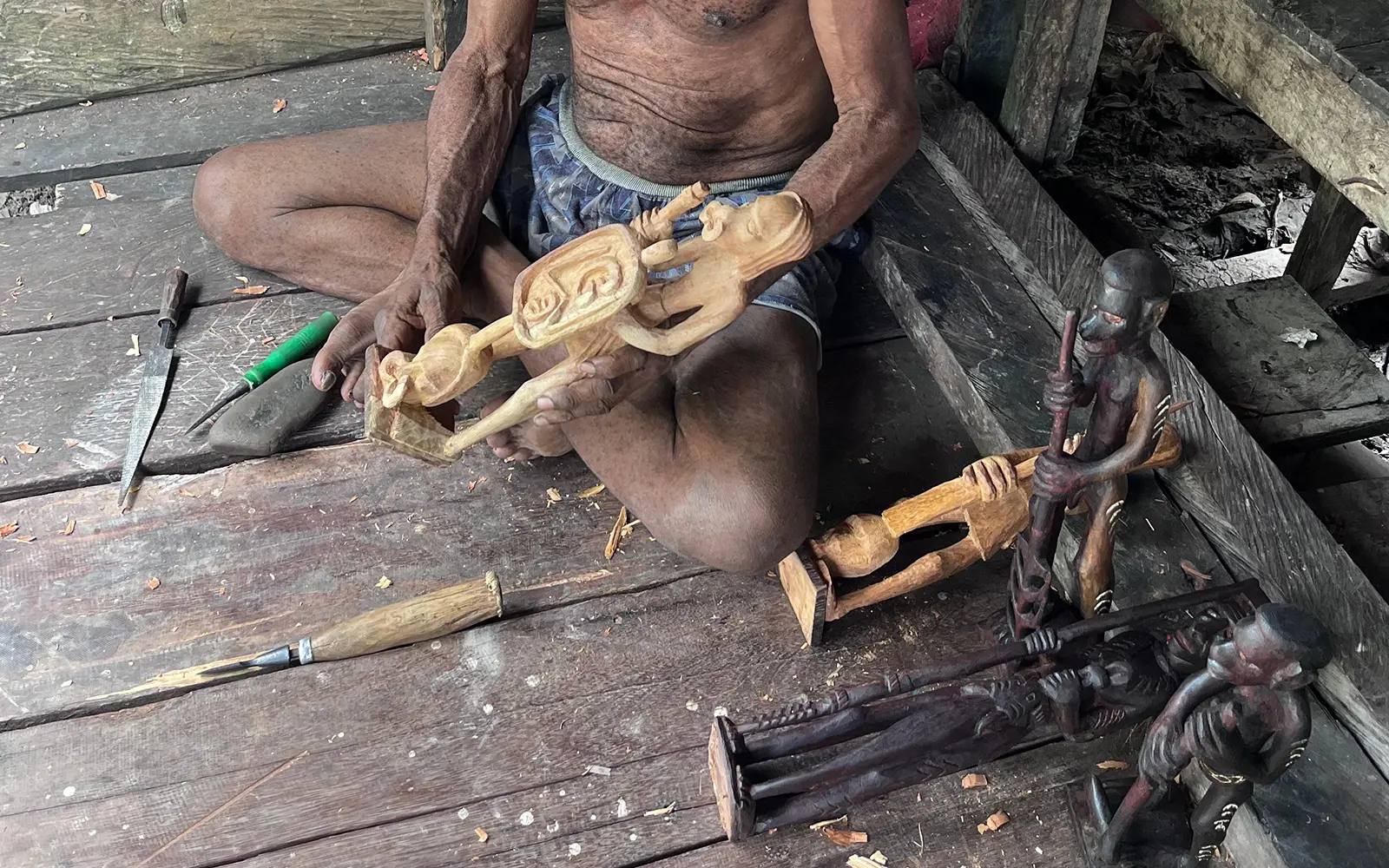
Watching a Carver: When Knowledge Passes Through Hands
There is something deeply absorbing about watching a wooden form gradually emerge beneath a carver's hands.
The process is physical and deliberate.
A tool follows the grain of the timber.
Small pieces fall away.
A surface begins to take shape.
A pattern slowly becomes recognisable.
There is rhythm in the movements, but also concentration and judgement.
The artist must understand the material.
The resistance of the wood.
Its natural form.
The possibilities and limitations of the chosen tools.
The intended shape of the finished work.
These are abilities developed through practice.
They can also be part of knowledge passed between generations.
A younger artist may work differently from a father, grandfather, or older mentor.
Tools change.
Markets change.
New materials become available.
Buyers may request different designs.
Contemporary artists may experiment with forms while continuing to draw inspiration from inherited traditions.
None of this means that the culture has become less authentic.
It means that the culture remains alive.
This may be one of the most important things to understand about Asmat carving.
The significance of the tradition is not simply that historical sculptures have survived.
It is that people continue to possess and develop the skills to create meaning through wood.
A museum can preserve an object.
An artist can continue the knowledge required to make another.
And when a visitor watches that artist work, the relationship between heritage and the present becomes visible.
The Asmat Museum: Understanding Before Exploring
For travellers arriving in Agats, the Asmat Museum of Culture and Progress deserves more than a hurried visit.
We think of it as preparation.
A place to slow down.
To observe.
And to begin understanding the visual language of Asmat culture before travelling farther into the surrounding communities.
Established in 1973, the museum was developed to support the preservation, documentation, and appreciation of Asmat cultural heritage.
Its collection includes objects representing the region's remarkable artistic traditions.
Carved shields.
Drums.
Paddles.
Ancestral figures.
Ceremonial sculptures.
And objects created for different practical, social, and cultural purposes.
Without interpretation, a visitor may see only an extraordinary collection of wooden artworks.
But with time and appropriate explanations, the objects begin to raise deeper questions.
Who made this?
Who was it made for?
What did the symbols represent?
Was the object used in daily life or in a ceremony?
Did it refer to a particular ancestor?
How has the tradition changed over time?
And what does it mean to the community today?
These questions are more important than simply identifying an object's age or appearance.
The museum also plays a role in connecting younger generations with aspects of their cultural history.
This matters because cultural preservation is not only about protecting objects from the past.
It is also about ensuring that knowledge remains accessible to the people whose heritage those objects represent.
A museum visit should not be treated as the final explanation of Asmat culture.
Rather, it should be the beginning of a more thoughtful journey.
It provides context for the carvings, stories, and artistic traditions that visitors may later encounter in the communities themselves.
The museum helps us recognise how much we still have to learn.
And that is a valuable starting point.
Canoes, Communal Houses, and the Architecture of Belonging
Asmat culture is inseparable from the waterways and forest environments of southern Papua.
For generations, canoes have supported transportation, fishing, communication, and connections between settlements.
Their construction reflects practical knowledge of timber, balance, water conditions, and the needs of the people who use them.
Like the carvings, a canoe can reveal the relationship between skilled craftsmanship and the surrounding forest.
A tree provides the material.
The builder gives it form.
The river gives it purpose.
Traditional communal houses, often referred to as jeu in relevant Asmat cultural contexts, represent another important aspect of the region's architectural heritage.
These spaces have historically been associated with social gatherings, collective activities, and ceremonial traditions, particularly within the communities where they form part of local practice.
Their significance cannot be reduced to architectural design alone.
They are connected to relationships within the community.
To the ways people gather.
To responsibilities and traditions.
To the transmission of knowledge.
Not every village maintains the same practices or structures, and access to communal spaces must depend on the wishes of local hosts.
For travellers, the most meaningful approach is to understand these places through the people who use them, rather than treating them as buildings that automatically belong on a sightseeing checklist.
Architecture, like carving, gains its deepest meaning through human relationships.
Sago, Forest, and the Knowledge of Everyday Life
Not every important cultural encounter involves a ceremony or a work of art.
Sometimes, understanding begins with food.
Sago remains closely associated with life in many parts of Papua, including Asmat.
At first glance, it may appear to be simply another staple served during a meal.
But following the process back to its source reveals a deeper relationship between people and the environment.
The palm must be located and selected.
Its usable material must be gathered.
The starch-rich interior is processed with skills that require knowledge of the plant, the tools, and the surrounding conditions.
What eventually becomes food is the result of labour, experience, and familiarity with the forest.
This relationship extends far beyond the meal itself.
The environment provides resources, but using them depends upon an understanding developed through generations.
Where to find suitable palms.
How to process them.
Which materials can serve additional purposes.
How waterways and seasonal conditions influence the movement of people and supplies.
These are forms of knowledge embedded in ordinary life.
A traveller focused only on dramatic cultural performances may overlook them.
Yet everyday activities often reveal the most enduring relationships between people and place.
Food reveals ecology.
Ecology reveals knowledge.
And knowledge reveals the connections that shape community life.
Agats Is Not a World Outside Time
Another important lesson emerges while walking through Agats.
A place can be geographically remote without being disconnected from the contemporary world.
Agats is part of Asmat.
But it is also part of modern Indonesia.
Churches stand within the town.
Schools connect younger generations with formal education.
Government offices provide administrative services.
Mobile phones and internet connections influence communication.
Goods arrive from other islands.
Traders and migrants contribute to the local economy.
Among these communities are people of Bugis origin, whose maritime history connects Sulawesi with many parts of eastern Indonesia.
For those of us coming from Sulawesi, hearing familiar accents and recognising aspects of everyday life so far to the east creates an unexpected sense of connection.
A name.
A familiar expression.
A conversation.
The presence of food or customs that remind us of home.
These details reveal something essential about Indonesia.
Its islands have never existed as completely separate worlds.
People have travelled, traded, settled, married, and exchanged ideas across the archipelago for generations.
Agats reflects these connections.
Asmat cultural identity exists alongside Christianity, modern institutions, economic activity, migration, education, and technological change.
These influences do not necessarily erase inherited traditions.
They become part of the circumstances in which communities continue to shape their lives.
The more interesting question is not whether Asmat has changed.
Every society changes.
The deeper question is how people continue to understand and express their cultural identity through those changes.
The people of Asmat do not live in a museum.
They live in the present.
And recognising this makes the journey more meaningful, not less.
The Camera: When Observation Becomes Responsibility
Asmat is visually extraordinary.
The rivers.
The mangroves.
The raised walkways.
The canoes.
The carved wooden forms.
The changing light over the wetlands.
It is easy to arrive thinking like a photographer.
We understand the temptation.
Every bend in the river seems capable of revealing another remarkable image.
But a camera can also create distance.
A person becomes a subject.
A home becomes a composition.
A cultural gathering becomes content.
A community becomes something observed rather than encountered.
There is nothing inherently wrong with photography.
It can preserve memories, communicate stories, and encourage appreciation of cultural heritage.
But the order matters.
Meet people first.
Learn about the place.
Understand the circumstances.
Ask permission where appropriate.
Respect private spaces and community expectations.
And recognise that some moments are not intended to be photographed.
The presence of a guide can help visitors navigate these considerations, but respectful behaviour remains the responsibility of every traveller.
Not every encounter requires a photograph.
Sometimes the more valuable memory is the conversation that took place before the camera was raised.
Or the moment when we decided not to raise it at all.
When the Rain Changes the Journey
There is one expectation that rarely survives unchanged during a journey through Asmat.
The expectation that everything will happen exactly according to schedule.
Rain arrives.
A boat is delayed.
The river changes.
Someone we had hoped to meet is occupied elsewhere.
A community has other responsibilities.
An intended activity becomes impractical.
Plans must change.
These situations are not automatically signs of poor organisation.
They often reflect the realities of travelling through a landscape where weather, water, and local life influence the movement of people.
The answer is not to promise that uncertainty can be eliminated.
It is to prepare carefully and allow enough flexibility to respond.
A professionally organised expedition should anticipate the possibility of delays.
Transport arrangements, available supplies, local coordination, accommodation, and contingency planning deserve particular attention.
Experienced local boat operators and guides can make a substantial difference in navigating changing conditions.
Yet even the best preparation cannot control the weather.
In remote Indonesia, an itinerary should provide a thoughtful structure.
It should never create the illusion that an entire living landscape will operate according to a visitor's timetable.
The quality of an expedition is not measured by the absence of challenges, but by the care, experience, and judgement used to manage them.
The Reality of Travelling to Asmat
For travellers considering an expedition to Asmat, realistic expectations are essential.
Depending on the route, travel commonly involves domestic flights to southern Papua, connections through Timika and Ewer, and onward journeys by boat through the waterways surrounding Agats.
Visiting communities farther from town may require additional river transfers.
The exact route depends on the itinerary, available transport, weather conditions, and local arrangements.
Accommodation in Asmat is generally more basic than in established tourism destinations.
Travellers should not expect the same selection of hotels, facilities, or services found in Bali, Jakarta, or other major travel centres.
Some itineraries involve simple guesthouses, while others combine basic accommodation with hotels in larger transit towns.
Medical facilities and communications can be limited, particularly away from Agats.
Visitors should therefore prepare carefully, consider their physical condition, and discuss appropriate travel-health precautions with qualified professionals.
The region's remoteness also means that transportation and expedition logistics can be costly.
Boats, fuel, local guiding, crew support, supplies, accommodation, and contingency arrangements all contribute to the practical requirements of a journey.
The most important question is not simply how inexpensively the destination can be reached.
It is whether the journey has been responsibly planned.
For travellers who value cultural understanding, specialist support, and meaningful encounters, this preparation is part of what makes the experience possible.
The Meaning of Luxury in Asmat
The word luxury takes on a different meaning in remote Papua.
It is not necessarily found in grand accommodation, elaborate dining, or polished resort facilities.
In Asmat, some of the most memorable experiences are inseparable from the simplicity of the environment.
A slow journey through the mangroves.
An introduction to a skilled woodcarver.
Time spent learning about the meanings of ancestral sculpture.
A conversation beside a village walkway.
A quiet moment as rain falls across the river.
These are experiences that cannot be manufactured through expensive infrastructure.
They depend on access arranged with respect, knowledgeable local support, careful planning, and enough time to appreciate what is happening.
In this setting, professional service means something different.
It means knowing how to organise transport across challenging waterways.
Selecting the most appropriate accommodation available for each stage.
Working with people who understand local conditions.
Making suitable arrangements with community hosts.
And helping travellers approach cultural encounters with sensitivity.
Comfort remains important.
But it must be understood within the realities of the destination.
The value of an expedition lies in the quality of the experience and the knowledge that supports it.
In Asmat, true luxury is not excess. It is the privilege of experiencing a remarkable cultural world with time, understanding, and thoughtful guidance.
Discovering Asmat with Pacébo
At Pacébo, we believe that exceptional journeys are shaped through local understanding, meticulous preparation, and a genuine respect for the people and places we visit.
Asmat is not a destination that should be approached through hurried sightseeing.
Its cultural importance cannot be captured in a single photograph, a brief village visit, or a quick stop at a museum.
A meaningful journey requires time.
Time to understand the waterways.
Time to appreciate the artistic traditions.
Time to learn from local guides.
And time to recognise the connections between wood, water, ancestry, and daily life.
Our private expeditions are designed around these principles.
We work with local teams to coordinate river transportation, guiding, appropriate accommodation, logistical arrangements, and cultural visits that respect the expectations of host communities.
For travellers whose primary interest is Asmat's artistic heritage and river cultures, our Asmat — Art, Ancestors & River Worlds journey offers a focused private expedition.
The itinerary introduces the raised walkways of Agats, the Asmat Museum of Culture and Progress, local woodcarving traditions, and journeys by boat to river communities, with village encounters arranged through local hosts.
For those wishing to explore more of southern Papua, our Korowai & Asmat — Forest Worlds, River Cultures & Remote Frontiers expedition connects Asmat's artistic heritage with the forest environments and cultural knowledge of the Korowai.
Travellers seeking a broader exploration can also discover Epic Papua — Highlands, Ancestors & Living Frontiers, a longer private journey connecting the Baliem Valley, the Korowai rainforest, and the river communities of Asmat.
Each of these journeys offers a different perspective on Papua's cultural and natural diversity.
But they share a common philosophy.
We do not believe that cultural travel should be reduced to collecting images of unfamiliar traditions.
We believe it should create opportunities for understanding.
We also recognise that remote journeys require realistic preparation.
Weather can change. River conditions can influence transport. Local communities have their own priorities, and cultural activities cannot always be scheduled for visitors.
Our role is to organise each journey with care, coordinate with knowledgeable local partners, and support travellers as they encounter the realities of the destination.
The objective is not simply to reach a remote place.
It is to make the journey meaningful, responsible, and worthy of the people and landscapes that make it possible.
If you are considering a private journey into Asmat, contact Pacébo to begin planning your Papua expedition. Our team can help shape an itinerary around your interests, travel dates, preferred pace, and the practical conditions of the region.
What We Carry Back from the River
When we remember Asmat, the largest images return first.
The great rivers.
The mangrove forests.
The raised houses.
The extraordinary carvings.
The remarkable distance separating these waterways from the familiar destinations of Indonesia.
But our field notes are also filled with smaller memories.
Wet shoes drying beside a doorway.
A motorcycle passing across a raised walkway in Agats.
A boat operator navigating the river with the confidence of someone who knows its changing character.
Wood shavings falling slowly beneath a carver's hands.
Children laughing when visitors attempt unfamiliar words.
A sudden rainstorm moving across the water.
Coffee shared while waiting for the next boat.
The quiet that follows when an engine stops.
These details are difficult to place inside a travel brochure.
Yet they are often the reason a journey remains with us.
Asmat reminds us that cultural knowledge does not exist only inside museums or formal ceremonies.
It lives within everyday activities.
In the work of skilled hands.
In the movement of people along rivers.
In the relationships between families.
In the knowledge of forests and tides.
In the meanings attached to objects.
And in the ways communities continue to adapt inherited traditions to the circumstances of contemporary life.
The privilege of travel is not simply that we are able to see another place.
It is that, for a brief moment, we are invited to encounter another way of understanding the world.
That invitation carries responsibility.
To listen carefully.
To remain curious.
To accept that we may not understand everything.
And to leave with respect for the people whose lives continue long after our departure.
Perhaps that is the most appropriate way to write about Asmat.
Not as though we have explained an entire culture.
Not as though the journey has answered every question.
But as travellers who arrived, observed, listened, learned something valuable, and returned with an appreciation far deeper than the one we carried with us.
These are only field notes.
Fragments from the waterways.
Memories from the mangrove world.
Reflections on the remarkable relationship between people, place, and artistic tradition.
Yet they carry something worth remembering.
The river carries people.
The forest provides.
The hands remember.
Discover Asmat with Pacébo — where private cultural expeditions become meaningful encounters with the living heritage, extraordinary waterways, and artistic traditions of southern Papua.