


Culture
Toraja: Where Ancestral Belief Lives in the Modern World
Pacébo · 13 September 2026
In the highlands of South Sulawesi, Toraja is a place where ancestral memory continues to shape modern life. Through tongkonan houses, funeral rituals, burial landscapes, family obligations, and traditions carried across generations, the past remains deeply present in the everyday.
There are places where culture is displayed.
And there are places where culture continues to shape the way people live.
Toraja belongs to the second kind.
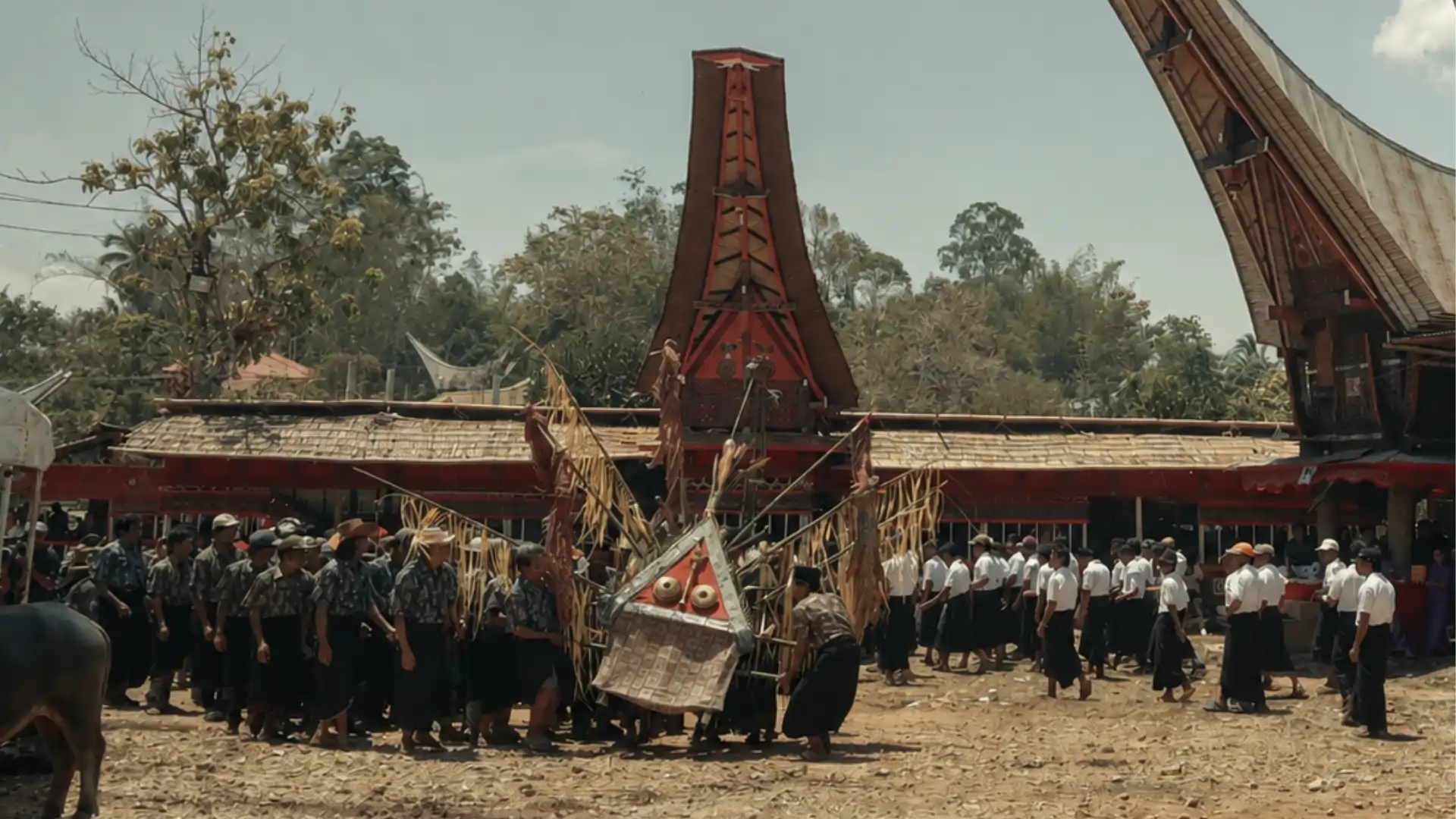
High in the mountains of South Sulawesi, among rice terraces, bamboo groves, carved cliffs, buffalo horns, and tongkonan houses rising beneath sweeping roofs, the Toraja people continue to live within a cultural world shaped by memory, family, obligation, and ancestry.
Here, tradition is not confined to museums.
It is not something brought out only for visitors.
It remains present in family houses, ceremonies, burial places, agricultural land, social relationships, and the responsibilities that connect one generation to another.
In Toraja, the past has never entirely left the present.
The ancestors remain close.
Long before roads connected the highlands to Makassar, before hotels appeared and before Toraja became known to travellers, photographers, anthropologists, and cultural explorers, life here was organised around an ancestral order often associated with Aluk To Dolo — the Way of the Ancestors.
To describe Aluk To Dolo simply as an old religion, however, would be too narrow.
It was a way of understanding the relationship between people, houses, land, animals, agriculture, ritual, family, life, death, and the unseen world.
Birth had its place within that order.
Marriage had its obligations.
Death required preparation.
The house carried lineage.
The land carried memory.
The buffalo carried meaning far beyond its economic value.
Nothing existed entirely on its own.
A tongkonan, for example, is more than an extraordinary piece of architecture.
It is a house of origin.

A place where lineage is remembered, family identity is anchored, and relationships between generations remain visible.
Its importance cannot be understood only through its carved walls or distinctive roof.
The building is also a social structure.
A family may live elsewhere for decades and still remain connected to the tongkonan from which they come.
In a similar way, the buffalo is more than livestock.
Within ceremonial life it can represent wealth, dignity, obligation, social connection, and passage.
And death itself is not understood simply as an ending.
It is a transition.
One that may require time.
Preparation.
Family.
Resources.
And collective responsibility.
In many modern societies, death is increasingly private. It is often separated from everyday life, managed quickly, and kept within a small circle.
Toraja offers a very different perspective.
Death brings people together.
Relatives return from Makassar, Jakarta, Bali, other islands, and sometimes from overseas.
Families gather.
Responsibilities are remembered.
Decisions are made.
The village becomes active.
The ancestral house once again becomes a point of return.
This is one of the reasons Toraja cannot be understood through a quick visit.
The visible elements are easy to photograph.
The meaning behind them takes longer.
A ceremony may appear to be about spectacle from the outside.
Buffalo.
Traditional clothing.
Processions.
Music.
Crowds.
But beneath the visual power lies something more intimate.
A family is grieving.
Obligations are being fulfilled.
Relationships are being acknowledged.
People who may have lived apart for years are gathering again around a shared history.
The ceremony belongs first to them.
The traveller is only a witness.
That difference matters.
A Culture Living in the Present
Toraja today is not a world frozen in the past.
Roads reach villages that were once far more difficult to access.
Families use smartphones and social media.
Young and old travel between Toraja and Indonesia’s major cities.
Modern education, government institutions, global communication, migration, and Christianity have become part of everyday life.
Yet modernity has not erased ancestral memory.
That is what makes Toraja so compelling.
A family may live a thoroughly contemporary life in Makassar or Jakarta.
They may work in an office.
Run a business.
Use modern technology.
Participate actively in Christian religious life.
And yet when a major family obligation arises in Toraja, the ancestral structure is still waiting.
The village still matters.
The tongkonan still matters.
Family responsibility still matters.
The dead still matter.
Ancestral memory still matters.
These things do not necessarily contradict one another.
They coexist.
Perhaps this is one of the most important ways to understand contemporary Toraja.
Tradition and modernity do not always stand on opposite sides.
People move between them.
They reinterpret them.
They carry different identities at the same time.
A person can participate in modern religious life while remaining deeply connected to ancestral customs.
A family can live far from Toraja while continuing to feel responsibility toward its ancestral house.
A ceremony can contain microphones, cars, mobile phones, modern clothing, and relatives arriving by plane while still being structured by ideas far older than any of those things.
The old world has not disappeared.
It has learned to live inside the new one.
When Belief Is More Than Religion
In Toraja, it can be useful to distinguish between formal religion and ancestral worldview.
Religion may provide faith, community, doctrine, and formal belonging.
Ancestral tradition operates differently.
It is woven into family.
Land.
Memory.
Kinship.
Status.
Obligation.
And the relationship between the living and those who came before them.
This helps explain why certain Toraja customs have continued even as the religious landscape of the highlands has changed dramatically.
Traditions survive not simply because people want to preserve something old.
They survive because they still do something.
They bring families together.
They define relationships.
They honour the dead.
They reaffirm belonging.
They connect people who have left the highlands with the place they still call home.
A tradition that continues to perform a social function is more than heritage.
It remains part of life.
A Ceremony Is Not an Attraction
For travellers, one of the most powerful experiences in Toraja can be witnessing a funeral ceremony.
But the word witnessing is important.
A Toraja funeral is not a show that begins when visitors arrive.
It happens because a person has died.
Because a family has obligations.
Because relatives have returned.
Because social and ancestral responsibilities must be fulfilled.
Travellers do not purchase the ceremony itself.
They may, under the right circumstances, be welcomed into a small part of it.
This distinction should shape the way we enter.
A funeral ceremony contains grief.
Pride.
Generosity.
Pressure.
Memory.
Sacrifice.
Reunion.
And social responsibility.
Photography may be permitted.
Guests may be welcomed.
Conversation may happen.
But none of this changes the fact that we are standing inside a real event in another family’s life.
Respect therefore comes before curiosity.
Introductions come before photographs.
Understanding comes before interpretation.
A meaningful visit to Toraja is not simply about finding out where a ceremony is taking place and arriving with a camera.
Context matters.
Who is the family?
What stage of the ceremony is taking place?
How should a visitor dress?
Where should we sit?
What is appropriate to photograph?
What should be left alone?
A knowledgeable local guide does more than explain what we see.
They help us understand how to enter.
The Architecture of Memory
Toraja’s cultural landscape extends far beyond ceremonies.
It is visible in the relationship between houses, graves, villages, agricultural land, and mountains.
The tongkonan is perhaps the most recognisable element.
Its sweeping roofline has become an icon of South Sulawesi.
But its deeper significance lies in what it represents.
A tongkonan carries genealogy.
It connects a family to a place.
It provides an architectural form for remembering who belongs to whom and where a lineage comes from.
Even when descendants live far away, the ancestral house can remain a point of identity.
Nearby rice barns, known as alang, form part of the same cultural landscape.
Buffalo horns displayed on the front of important tongkonan can tell stories of ceremonies held and animals sacrificed over time.
The architecture becomes a visible archive.
Memory is not kept only in writing.
It is built.
Landscapes of the Dead
Toraja is also famous for its burial landscapes.
Cliff graves.
Rock-cut tombs.
Caves.
Wooden effigies known as tau-tau.
Ancient burial places.
Newer family tombs.
To unfamiliar eyes, these places can appear dramatic.
But their importance goes beyond visual impact.
They reveal another understanding of the relationship between the living and the dead.
The dead do not simply disappear from the landscape.
They remain within it.
Graves can be close to villages.
Ancestors remain associated with family territory.
Memory occupies physical space.
For travellers, these sites deserve the same care as ceremonies.
They are not merely unusual places to photograph.
They are burial grounds.
Family places.
Landscapes of remembrance.
The most respectful way to visit them is to recognise what they are before admiring how extraordinary they look.
The Buffalo and the Meaning of Obligation
Few animals are as closely associated with Toraja as the buffalo.
To a visitor, the scale of buffalo sacrifice during certain ceremonies may be difficult to understand.
The first reaction is often visual or emotional.
But within Toraja society, buffalo carry layers of cultural and social meaning.
They can represent wealth.
Status.
Exchange.
Respect.
Ceremonial obligation.
And the relationship between a family and the wider community.
Certain buffalo may have exceptionally high value because of colour, markings, horns, age, or cultural significance.
Yet focusing only on price misses the broader picture.
The buffalo belongs to a social system.
Its meaning is not limited to the moment of sacrifice.
It exists within networks of obligation and identity that can extend across generations.
This does not mean travellers must share every cultural perspective they encounter.
Cultural understanding is not the same as unquestioning agreement.
It means taking the time to understand why a practice exists before judging it only through our own assumptions.
What Modernity Has Changed — and What It Has Not
Toraja has changed enormously.
Tourism has changed it.
Migration has changed it.
Christianity has changed it.
Education has changed it.
Roads, telecommunications, government, commerce, and social media have changed it.
But change is not the same as disappearance.
Cultures have never survived by remaining untouched.
They survive by adjusting.
Negotiating.
Selecting.
Remembering.
Sometimes letting go.
Sometimes holding on more strongly.
Toraja is powerful precisely because this negotiation remains visible.
A traditional ceremony may take place beneath temporary structures while guests record parts of it on smartphones.
A tongkonan may stand beside a modern concrete house.
A relative may fly home from another country to fulfil a responsibility defined by ancestral kinship.
The elements may look contradictory from the outside.
For the people living them, they can belong to the same reality.
This is not a culture caught between the past and the future.
It is a culture carrying both.
What the Traveller Should Understand
Toraja can easily become visually overwhelming.
The architecture is extraordinary.
The landscapes are beautiful.
The ceremonies are powerful.
The burial sites are unlike almost anywhere else.
And this creates a danger.
A traveller can begin collecting images without understanding what they represent.
Tongkonan.
Buffalo.
Tau-tau.
Funerals.
Cliff graves.
Traditional clothing.
One photograph after another.
But Toraja becomes far more meaningful when we stop treating culture as a list of things to see.
A house becomes lineage.
A buffalo becomes obligation.
A grave becomes memory.
A ceremony becomes family.
A landscape becomes belonging.
This is the difference between looking and understanding.
Travel Slowly
Toraja rewards time.
Not necessarily because every journey needs to be long, but because the highlands reveal themselves gradually.
Morning mist over the rice fields.
Coffee shared beneath a tongkonan.
A market beginning to fill.
A family preparing for guests.
The sound of bamboo in the wind.
A road climbing through mountain villages.
A conversation about someone who left Toraja years ago and still returns whenever the family needs them.
These moments rarely appear on a checklist.
Yet they often reveal more about Toraja than the most famous sites.
A good journey therefore leaves room for things that cannot be scheduled perfectly.
Ceremonies belong to families, not to tourism calendars.
Plans can change.
A village may be busy with something unexpected.
The most meaningful encounter may not be the one advertised in advance.
To travel well here is to remain flexible.
Pacébo’s Approach to Toraja
For Pacébo, Toraja is not simply a collection of attractions.
It is a cultural landscape.
Our role is not only to move travellers between Rantepao, traditional villages, burial sites, markets, and viewpoints.
It is to provide context.
To explain what can be explained.
To recognise what should remain private.
To help guests understand how to behave inside living cultural spaces.
And, when a ceremony can appropriately be visited, to approach it as guests rather than spectators.
The objective is not to make Toraja more dramatic.
It does not need that.
The objective is to help travellers see more deeply.
Where the Past Remains Present
Perhaps the most remarkable thing about Toraja is not that old traditions have survived.
It is the way they continue to participate in contemporary life.
Ancestral belief has not remained untouched.
Nor has Toraja.
Both have changed.
But memory remains powerful enough to call families home.
The tongkonan still anchors identity.
The village still carries belonging.
The dead remain part of family memory.
And obligations formed generations ago continue to influence decisions made today.
This is why Toraja feels different from a place where heritage survives mainly inside monuments.
Here, heritage still asks something from people.
Time.
Money.
Presence.
Responsibility.
Return.
Toraja is ancient, but it is not trapped in the past.
It is modern, but it is not rootless.
It welcomes visitors, but it does not exist for them.
Its culture continues because the people of Toraja continue to carry it.
Not as spectacle.
Not as nostalgia.
But as responsibility.
As memory.
As belonging.
In Toraja, the ancestors are not entirely distant.
They remain in the house.
In the land.
In the ceremony.
In the grave.
In the obligations of the living.
And perhaps this is what makes a journey here so profound.
Toraja does not simply ask us to look at the past.
It allows us to see how the past continues to live inside the present.