


Culture
Toraja: Where Ancestral Beliefs Still Shape Modern Life
Pacébo · 15 June 2026
In the highlands of South Sulawesi, ancient traditions are not simply remembered. They remain woven into family life, architecture, ceremonies, and the enduring relationship between the living and their ancestors.
There are places where history is preserved behind museum walls, where traditions are remembered through monuments and stories of a distant past. And then there are places where heritage continues to shape everyday life, influencing how people build their homes, honour their families, celebrate important occasions, and remember those who came before them.
Toraja belongs to the latter.
Hidden among the mountains of South Sulawesi, Indonesia, this remarkable highland region is home to a cultural landscape unlike almost anywhere else. Traditional tongkonan houses rise above fertile valleys, terraced rice fields follow the contours of the mountains, and ancient burial sites remain embedded in limestone cliffs.
Yet the true significance of Toraja lies beyond its extraordinary scenery.
It is found in the enduring relationship between people, ancestry, land, and family — a relationship that continues to influence Torajan life even in an increasingly modern world.
To understand Toraja is to discover that the past does not always disappear with time. Sometimes, it continues to live alongside the present.
Aluk To Dolo: The Ancestral Philosophy of Toraja
Long before Christianity became widespread in the Toraja highlands, the lives of local communities were guided by an ancestral belief system known as Aluk To Dolo, often translated as the Way of the Ancestors.
Describing Aluk To Dolo simply as an ancient religion would overlook much of its significance.
Traditionally, it provided a broader framework for understanding the relationship between human beings, the natural world, the spiritual realm, and generations of ancestors.
Within this worldview, life was not composed of separate and unrelated events. Birth, marriage, agriculture, family obligations, social relationships, and death formed part of an interconnected order.
The ancestral house represented lineage and belonging. Land carried the memory of generations. Animals, particularly water buffalo, held ceremonial significance extending far beyond their economic value.
Death, too, was understood not merely as the conclusion of an individual life, but as part of a continuing relationship between the living and those who had passed away.
Although religious life in Toraja has changed considerably, and most Torajans today identify with Christianity, elements of ancestral customs remain deeply embedded in family and community life.
The relationship between traditional practices and contemporary religious beliefs is complex and varies between families and communities. For many, however, ancestral customs continue to express identity, kinship, and responsibilities inherited across generations.
This coexistence is among the most fascinating aspects of contemporary Toraja.
Ancient beliefs have not simply survived as historical memories. Their influence remains visible in the decisions people make, the ceremonies they organise, and the obligations they continue to honour.
Tongkonan: Houses That Carry Generations of Memory
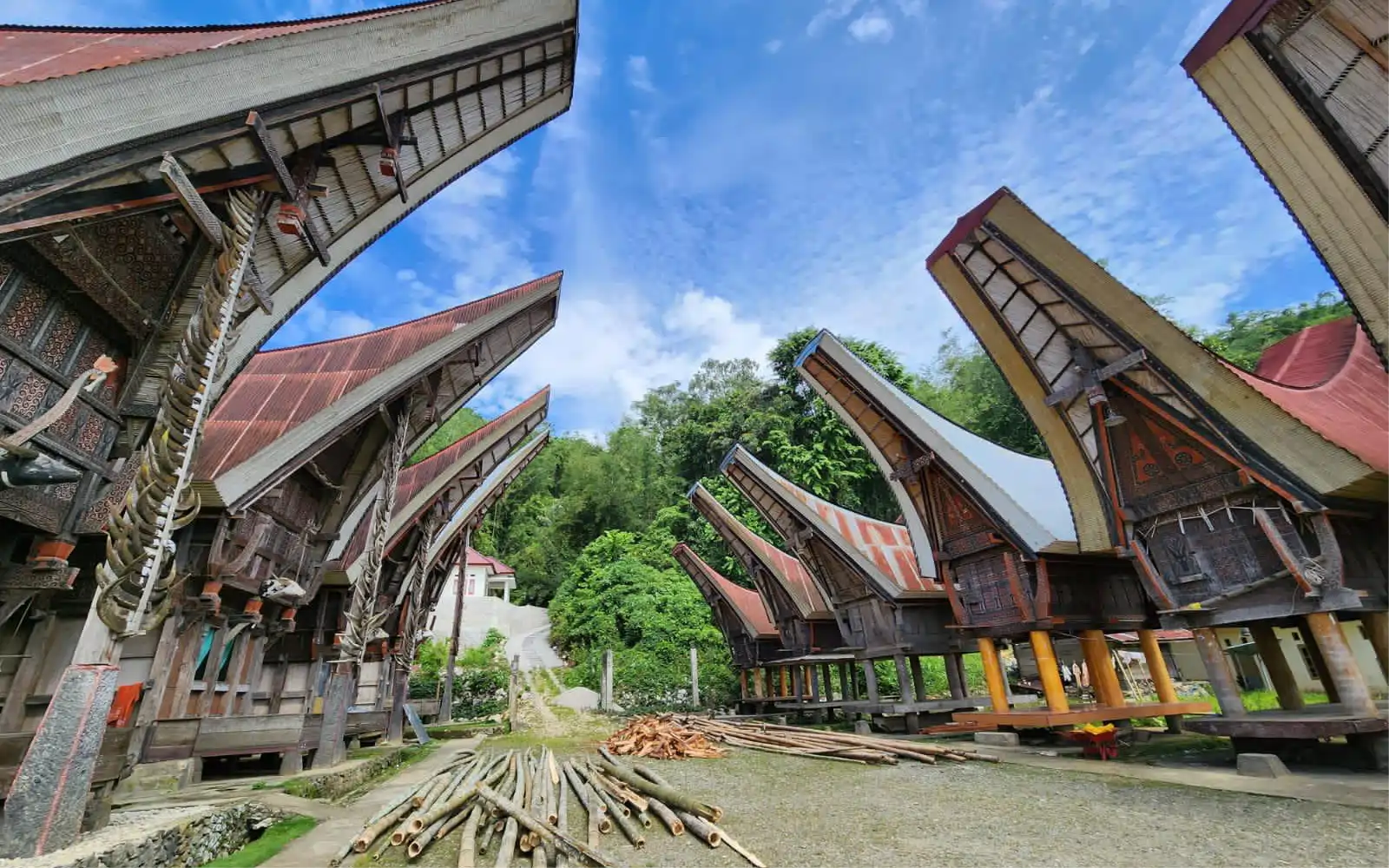
Perhaps no architectural symbol is more closely associated with Toraja than the tongkonan.
With its dramatic, upward-curving roof and richly carved wooden walls, a tongkonan is immediately recognisable. Its silhouette has become one of the defining images of South Sulawesi.
Yet its importance extends far beyond architecture.
A tongkonan is an ancestral house, a centre of family identity, and a lasting connection to the origins of a lineage.
It represents continuity between generations, linking descendants to the people and places from which their families emerged.
Even when family members move to Makassar, Jakarta, or other parts of the world, their ancestral tongkonan may remain an important point of belonging.
During significant family events, relatives return to these houses, sometimes travelling considerable distances to fulfil responsibilities connected to their shared heritage.
The surrounding architecture adds further meaning to the landscape. Traditional rice barns, known as alang, stand opposite many tongkonan, while elaborate carvings communicate cultural values and family histories.
On certain houses, rows of buffalo horns record ceremonial sacrifices associated with the family over time.
What may initially appear to be decorative architecture is therefore something much more meaningful.
A tongkonan is a place where family history becomes visible, where ancestry takes architectural form, and where belonging is preserved across generations.
Death, Family, and the Meaning of Farewell
One of the most distinctive aspects of Torajan culture is the significance given to funeral ceremonies.
In many parts of the modern world, death has become an increasingly private experience. Farewell ceremonies are often brief, and mourning takes place within a relatively small circle.
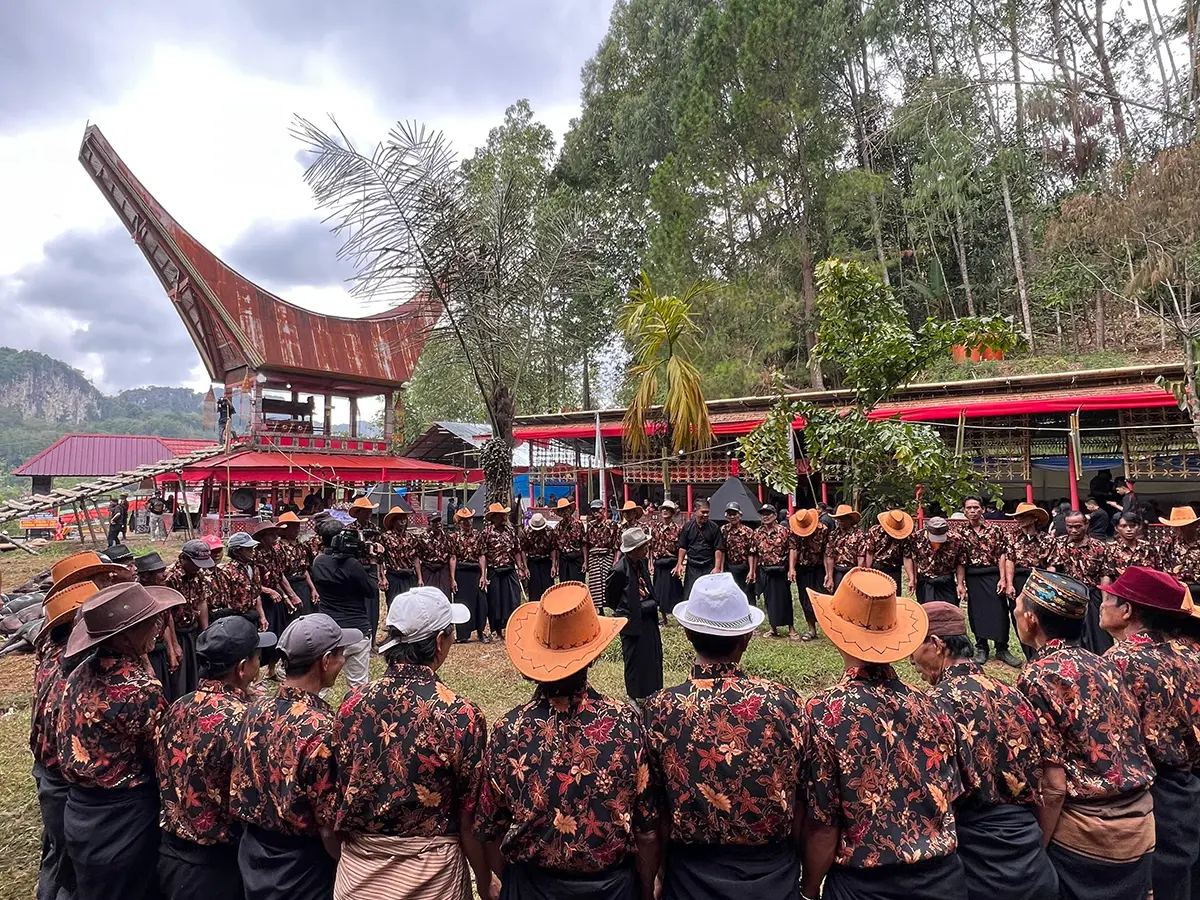
In Toraja, major funerals can bring together an extended network of relatives, neighbours, and communities.
Family members return from cities throughout Indonesia and sometimes from overseas. Preparations may involve extensive discussions, considerable resources, and responsibilities shared among different branches of a family.
The ceremony becomes more than a moment of farewell.
It is also an occasion of reunion, remembrance, and the reaffirmation of social relationships.
Traditional funeral practices, particularly those associated with the ancestral belief system, reflect an understanding of death as a transition rather than simply an ending.
Depending on the family, its traditions, and circumstances, significant time may pass between a person's death and the final funeral ceremony.
For an unfamiliar visitor, these events can appear extraordinary. Elaborate ceremonial structures, traditional clothing, music, processions, and the presence of buffalo create powerful visual impressions.
But focusing only on what can be seen risks overlooking what matters most.
Behind every ceremony is a family remembering someone they have lost. Behind every gathering are relationships, obligations, emotions, and memories that extend across generations.
The ceremony belongs first and foremost to the family.
Visitors, when welcomed, are guests within an intimate and meaningful occasion.
Understanding that distinction is essential to experiencing Toraja respectfully.
The Water Buffalo: More Than a Symbol of Wealth
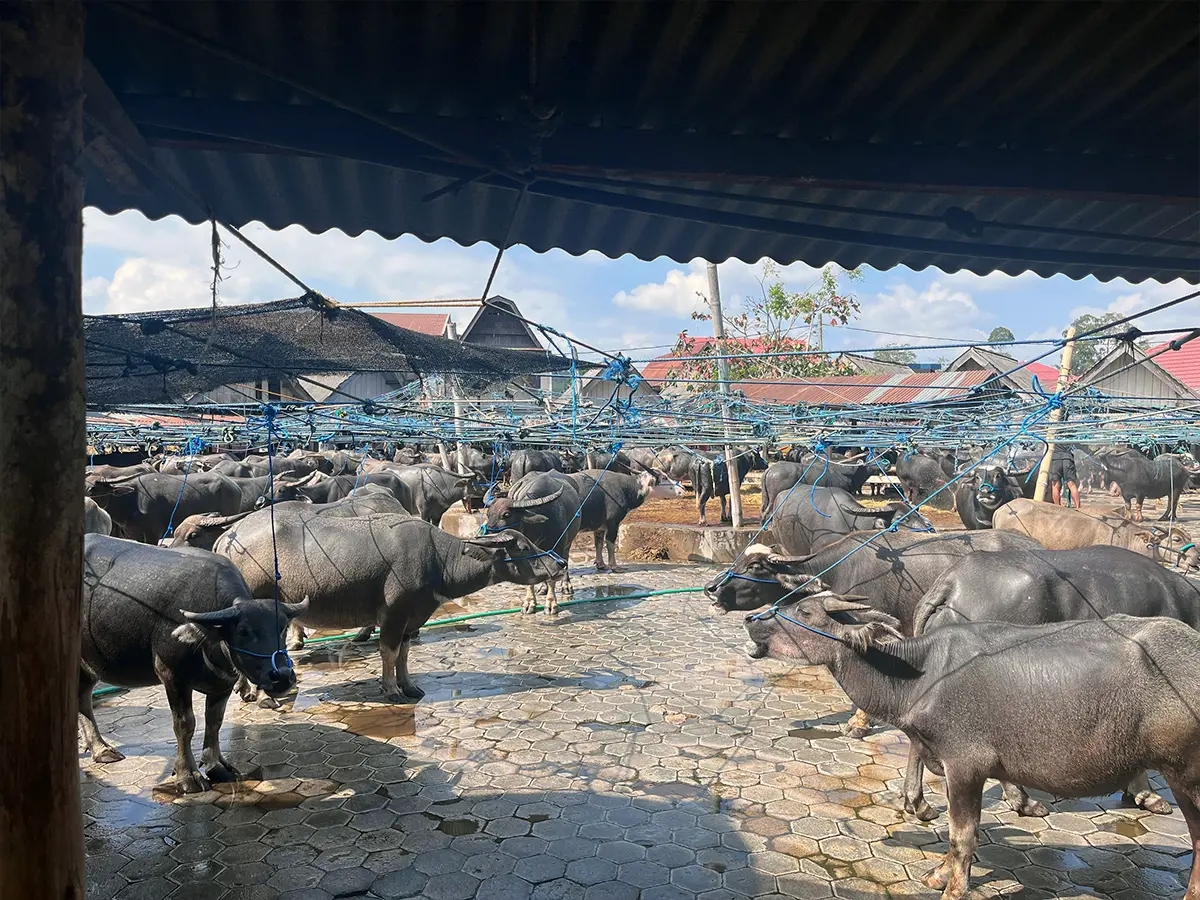
Few animals hold such an important place in Torajan ceremonial traditions as the water buffalo.
In certain traditional funeral ceremonies, buffalo sacrifice carries profound symbolic and social significance.
Within the ancestral worldview, the buffalo has long been associated with the journey of the deceased into the spiritual realm. It also represents family honour, ceremonial responsibility, wealth, and relationships within the wider community.
Some buffalo are especially valued for their distinctive colouring, markings, physical characteristics, and cultural significance.
Yet understanding their importance requires looking beyond monetary value.
For families participating in traditional ceremonies, buffalo may form part of a system of social exchange and obligation that has developed over generations.
Their role reflects the interconnected nature of family relationships and the responsibilities people maintain toward one another.
For international travellers, some aspects of these ceremonies — particularly animal sacrifice — can be emotionally challenging.
Cultural understanding does not require unquestioning agreement with every practice encountered. It does, however, require a willingness to listen and to recognise that traditions may carry meanings beyond those immediately apparent to an outsider.
Approaching these moments with sensitivity allows travellers to understand Toraja with greater depth and respect.
Landscapes of Remembrance: The Burial Traditions of Toraja
Throughout the Toraja highlands, the relationship between the living and the deceased is also reflected in the landscape itself.
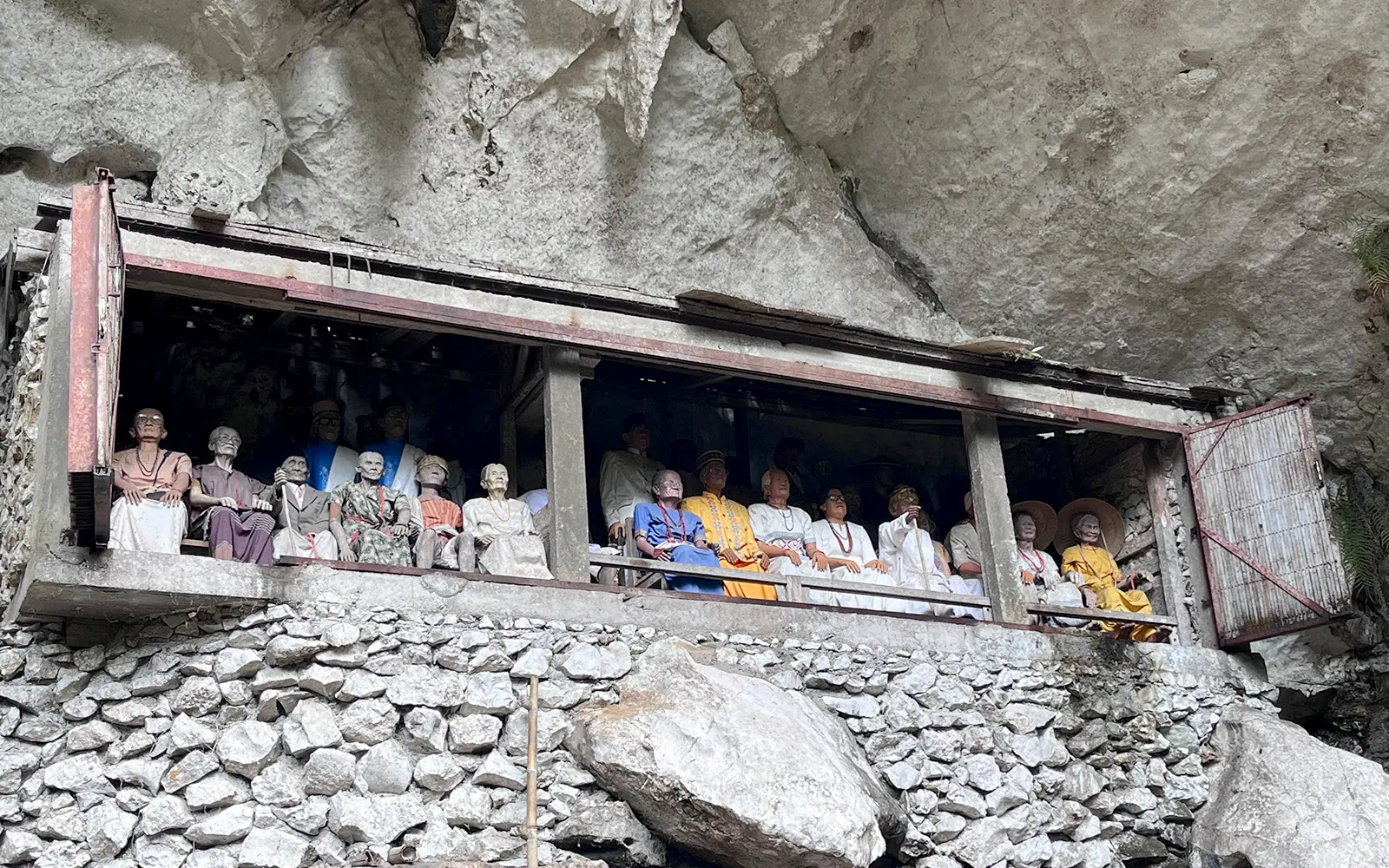
Ancient burial caves, rock-cut tombs, cliffside graves, and wooden effigies known as tau-tau reveal distinctive traditions of remembrance.
In some places, burial chambers have been carved into limestone cliffs. Elsewhere, graves occupy caves or family burial sites associated with ancestral territories.
These places can be visually striking, particularly when surrounded by dramatic mountain scenery and dense tropical vegetation.
But they should never be understood merely as unusual tourist attractions.
They are places of remembrance and, in many cases, continuing emotional and ceremonial importance to the families connected with them.
The presence of ancestral graves within the landscape reveals an important aspect of Torajan cultural identity.
The dead are not simply removed from the places where their descendants continue to live.
Through burial sites, ancestral houses, ceremonies, and family memory, connections with earlier generations remain part of the physical and social environment.
To visit these landscapes thoughtfully is to recognise that their significance lies not only in their appearance, but in the stories and relationships they preserve.
An Ancient Culture in a Modern World
Toraja is sometimes portrayed as a place where time has stood still.
In reality, nothing could be further from the truth.
Contemporary Torajans participate fully in modern Indonesian society. They work in businesses, universities, government institutions, and professions across the country and beyond.
Smartphones, social media, contemporary architecture, modern education, and international travel are all part of everyday life.
Christianity has profoundly influenced the region's religious landscape, while migration has connected Torajan communities to cities and countries far beyond their ancestral homeland.
And yet many traditional structures of family identity and social responsibility remain influential.
A person may spend most of their life working in Jakarta but continue to recognise obligations connected to an ancestral tongkonan.
A family may practise Christianity while maintaining cultural traditions inherited from previous generations.
A traditional ceremony may bring together relatives arriving by aircraft and automobile, communicating through mobile phones, yet participating in customs whose origins precede the modern world.
These realities are not necessarily contradictory.
They demonstrate how cultures evolve while maintaining connections to their origins.
Toraja is not simply preserving the past in opposition to modernity. Its people are continually negotiating the relationship between inherited traditions and contemporary life.
This ability to carry ancestral memory forward is what makes Toraja particularly compelling.
Its culture is neither entirely ancient nor entirely modern.
It is both.
Experiencing Toraja Beyond the Famous Sights
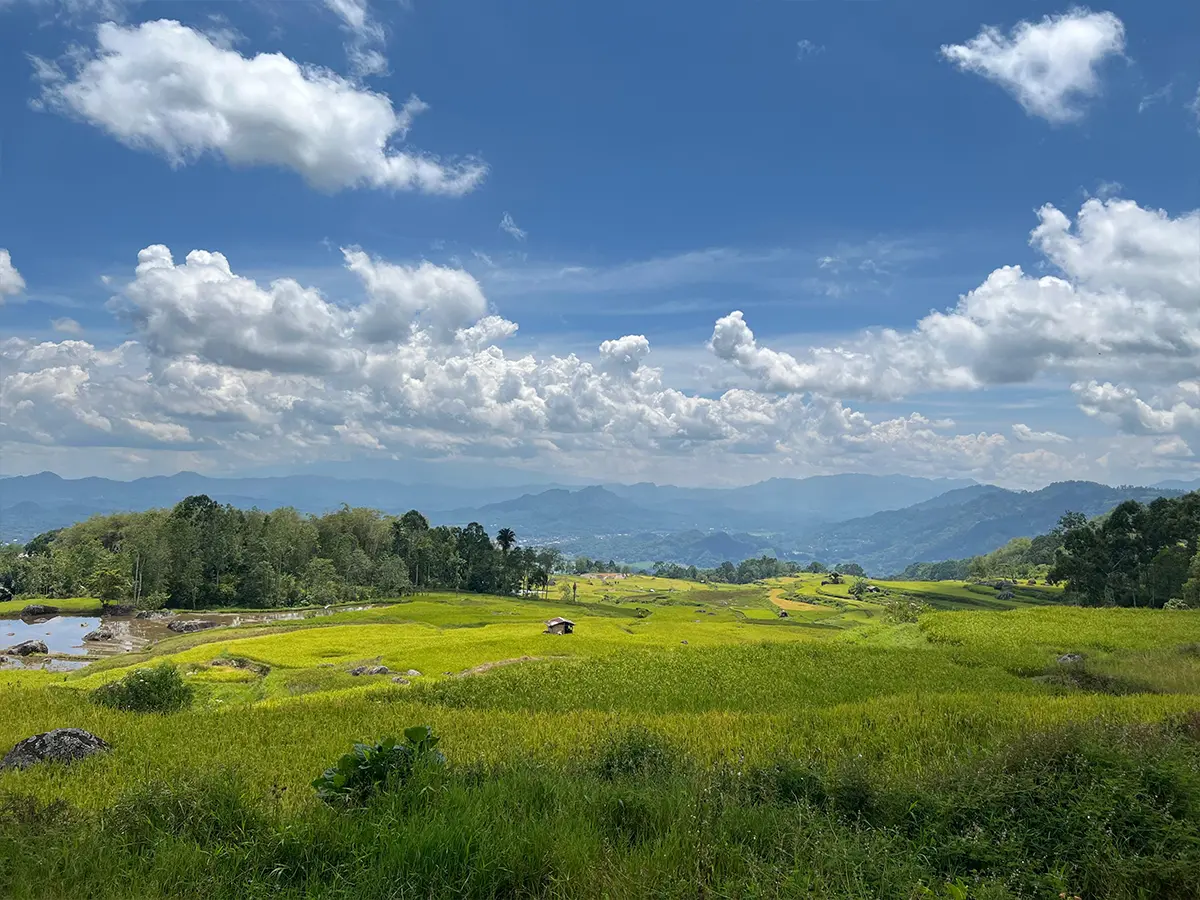
The landscapes and architecture of Toraja are undeniably beautiful.
Traditional houses, mountain villages, terraced rice fields, local markets, limestone cliffs, and extraordinary burial sites provide countless opportunities for exploration and photography.
But the most memorable experiences often come from understanding the stories behind these places.
A tongkonan becomes more meaningful when its connection to family lineage is explained.
A traditional ceremony takes on a different significance when visitors understand the relationships and responsibilities involved.
A burial site becomes more than an impressive landscape when its role in ancestral remembrance is recognised.
Even an ordinary conversation can offer a deeper perspective on Torajan life.
A family member describing the history of their ancestral house, a local guide explaining ceremonial etiquette, or a quiet moment in a highland village may reveal more than a hurried sequence of sightseeing stops.
To experience Toraja fully is not simply to see its famous landmarks.
It is to appreciate how those landmarks connect to the people who continue to live among them.
Visiting Living Traditions with Respect
Cultural travel carries responsibilities, particularly when visitors encounter ceremonies and traditions that remain part of private family life.
A funeral ceremony does not take place for the benefit of travellers. It is organised according to family circumstances, customs, and responsibilities.
Its timing, accessibility, and character cannot always be predicted, and attendance should never be assumed.
When visitors are welcomed, respectful behaviour becomes essential.
Appropriate dress, introductions, photography etiquette, and an understanding of where guests may sit or move all contribute to a considerate experience.
Some moments may be suitable for observation, while others should remain private.
This is where a knowledgeable local guide becomes particularly valuable.
A good guide does more than identify monuments or translate explanations.
They help visitors understand the cultural context of what they encounter, navigate local expectations, and recognise the boundaries between public experience and private family life.
The difference between observing a ceremony and understanding it can be profound.
And sometimes, the most respectful decision is simply to observe quietly or put the camera away.
The Beauty of Travelling Slowly
Toraja rewards travellers who are willing to slow down.
Not every meaningful experience can be arranged according to a fixed itinerary, and not every important encounter happens at a famous landmark.
The atmosphere of the highlands reveals itself gradually.
Morning mist drifting above rice terraces. Traditional houses emerging from the greenery. Small villages connected by winding mountain roads. Coffee shared during an unhurried conversation. Families preparing for a gathering. The quiet beauty of rural landscapes shaped by generations of agricultural life.
These moments form an essential part of understanding the region.
They reveal Toraja not simply as a destination, but as a living community with its own rhythms, responsibilities, and relationships.
Travelling slowly also leaves room for the unexpected.
A local gathering may offer an opportunity for cultural exchange. A conversation may reveal a family history. An unscheduled stop may become one of the most memorable moments of the journey.
In Toraja, the richest experiences are not always the most dramatic.
Often, they are the ones that allow travellers to feel a genuine connection with the place and its people.
Discovering Toraja with Pacébo
At Pacébo, we believe that meaningful travel begins with understanding.
Toraja is not simply a collection of cultural attractions to be visited in succession. It is a living heritage landscape whose significance deserves time, knowledge, and sensitivity.
Our approach to exploring Toraja is built around thoughtful itineraries, experienced local guidance, carefully selected accommodation, comfortable private transportation, and a genuine appreciation for the communities that make this region extraordinary.
We believe the quality of a journey is measured not only by the places visited, but also by the depth of the experience.
Our guides help travellers look beyond the surface, bringing cultural context to traditional villages, ancestral houses, burial landscapes, and the customs that continue to influence local life.
When appropriate opportunities arise to witness a traditional ceremony, we approach them with respect for the families involved, recognising that these are meaningful personal occasions rather than performances arranged for tourism.
We also understand that a memorable journey requires a balance between cultural discovery, comfort, thoughtful planning, and the flexibility to embrace unexpected experiences.
Our aim is not simply to show travellers Toraja.
It is to help them understand why Toraja matters.
Explore Toraja with Pacébo and discover a journey shaped by local knowledge, cultural sensitivity, and a more meaningful way of travelling.
Where the Past Continues to Live
Perhaps the most extraordinary aspect of Toraja is not the survival of its ancient traditions, but the ways in which they continue to influence contemporary life.
Ancestral houses still bring families together. Ceremonies continue to express relationships and responsibilities. Burial landscapes preserve the memory of earlier generations. And people who have built their lives far from the highlands may still feel a powerful connection to the places from which their families came.
Traditions have changed, as all living cultures do.
But change has not erased the importance of belonging.
Toraja reminds us that heritage is not always something left behind for future generations to admire. Sometimes, it remains an active part of life, asking people to remember, to return, and to honour their relationships with others.
This is what makes a journey through Toraja so memorable.
Beyond the remarkable architecture, the dramatic landscapes, and the powerful ceremonies lies a deeper story about continuity, identity, and the human need to belong.
In Toraja, the past is not simply a distant chapter of history.
It continues to live in the present.