


Culture
Baliem Valley Cultural Festival: A Complete Guide to Papua’s Highland Celebration
Pacébo · 13 September 2026
High in the mountains of Papua, surrounded by steep green ridges and the broad landscapes of the Baliem Valley, communities from across the Jayawijaya highlands gather each year for one of eastern Indonesia’s most remarkable cultural events.
The Baliem Valley Cultural Festival, known locally as Festival Budaya Lembah Baliem, brings together dance, music, traditional games, communal cooking, craftsmanship, ceremonial dress, and performances inspired by the cultural traditions of Papua’s highlands.
For travellers, the festival offers a rare opportunity to experience Wamena at its most vibrant.
But the Baliem Valley is much more than a festival ground.
Beyond the crowds and performances lies a highland world of villages, gardens, honai houses, suspension bridges, mountain trails, sweet potato fields, noken weaving, and communities whose traditions continue to evolve within modern Papua.
To experience the festival well is therefore not simply to attend an event.
It is to understand something of the valley around it.
Where Is the Baliem Valley?
The Baliem Valley lies in Jayawijaya Regency, Papua Pegunungan, with Wamena serving as the principal gateway to the region.
Surrounded by high mountain ranges, the valley sits at roughly 1,600 metres above sea level. The landscape is dramatically different from the tropical coastlines often associated with Indonesia.
Mornings can be cool.
Mist settles between the mountains.
Gardens spread across the valley floor.
Rivers cut through the highlands.
Beyond Wamena, roads gradually give way to smaller settlements, walking trails, agricultural land, and mountain communities.
It is this landscape that gives the festival much of its atmosphere.
The performances do not take place in isolation.
They belong to a wider highland cultural world.
When Is the Baliem Valley Cultural Festival Held?
The festival is generally held in August, although the exact dates, programme, and location should always be confirmed for each year.
The 34th Baliem Valley Cultural Festival in 2026 formed part of a programme running from 7 to 10 August. The main cultural festival was held in Walesi District on 7–8 August, while additional activities in Wamena, including Wamena Coffee Street and Noken Street, continued through 10 August, when the programme concluded with a cultural carnival.
Because flights and suitable accommodation in Wamena are limited during the festival period, planning well in advance is strongly recommended.
Travellers should avoid assuming that dates will remain identical from one year to the next.
The local authorities determine the final programme each year.
What Happens During the Festival?
The Baliem Valley Cultural Festival is not centred around a single performance.
It brings together different expressions of highland culture, community participation, traditional skills, food, music, dance, and contemporary cultural creativity.
The 2026 edition included traditional dances and arts, Bakar Batu, pig racing, traditional games such as sikoko and puradan, and a wider cultural programme in Wamena. The closing programme also included a Nusantara cultural carnival and participation from dancers from Papua New Guinea.
Among the experiences travellers may encounter are some of the following.
Traditional War Performances
One of the festival’s best-known sights is the simulated highland battle.
Groups of participants carrying bows, arrows, spears and traditional shields move across the open field in coordinated formations.
For photographers, the spectacle is extraordinary.
But it is worth looking beyond the visual drama.
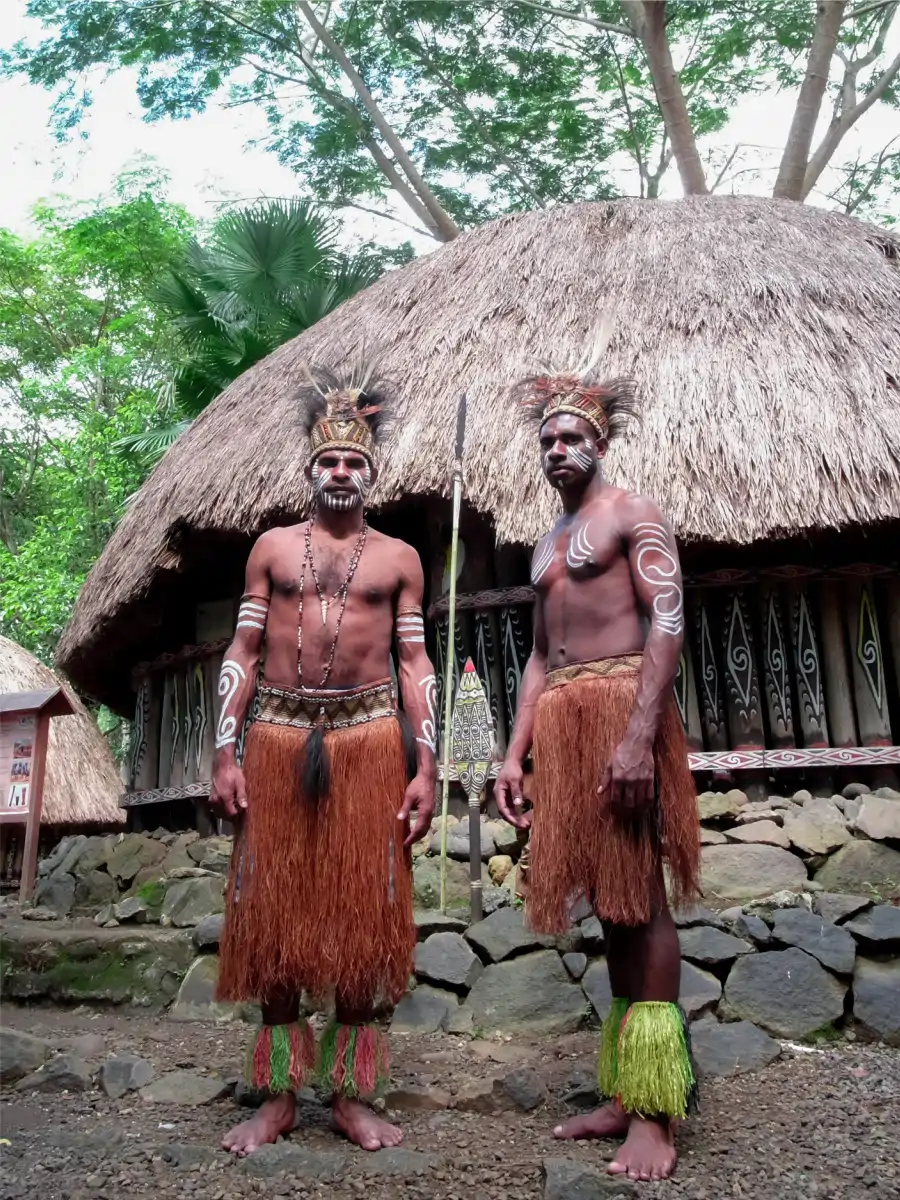
Weapons, body decoration, dress, movement and group identity all belong to a much wider cultural history of Papua’s highland communities.
The festival transforms these elements into public cultural presentation rather than actual conflict.
Dance, Song and Highland Traditions
Traditional dance is central to the atmosphere of the festival.
Groups arrive wearing forms of traditional highland dress and decoration, accompanied by song, chanting and rhythmic movement.
Different communities may bring their own styles and expressions.
Rather than viewing these performances simply as entertainment, travellers should remember that many of the forms, objects and gestures seen during the festival come from cultural traditions that continue beyond the festival grounds.
Bakar Batu
One of the most meaningful communal traditions presented during the festival is Bakar Batu, or stone cooking.
Stones are heated over a fire and used to cook food in layers, traditionally including meat and local produce.
But Bakar Batu is more than a cooking technique.
Throughout Papua’s highlands, forms of communal stone cooking are associated with gathering, sharing food and bringing people together.
Watching the process can therefore tell us as much about social relationships as it does about food.
Noken, Craft and Contemporary Creativity
The festival also provides space for traditional crafts and local products.
The noken, Papua’s characteristic handwoven or knotted bag, remains one of the most recognisable cultural objects of the highlands.
In 2026, Wamena’s programme also included Noken Street Fashion, demonstrating how cultural materials can move between inherited traditions and contemporary creative expression.
This is an important reminder.
Culture is not valuable because it remains frozen.
It remains alive because people continue to use, reinterpret and give meaning to it.
More Than a Festival
It is easy to fly to Wamena, attend the festival for a day, take hundreds of photographs and believe that one has experienced the Baliem Valley.
But the festival is only an introduction.
The valley becomes much more interesting when we leave the main event behind.
A road leads away from Wamena.
The crowds disappear.
The mountains become more dominant.
Gardens appear beside villages.
Smoke rises from honai compounds.
People walk between settlements carrying produce, tools or noken.
The pace changes.
This is where a journey through the Baliem Valley begins to reveal another side of the highlands.
Walking Through the Valley
Some of the most rewarding experiences in the Baliem region happen on foot.
Walking routes connect villages, gardens, rivers and mountain landscapes.
Depending on the itinerary and physical ability of the traveller, a journey can involve anything from gentle cultural walks to more demanding trekking through the surrounding highlands.
Suspension bridges cross rivers.
Narrow paths move between gardens.
Traditional honai compounds appear among cultivated land.
The valley is not wilderness without people.
It is a cultural landscape shaped by generations of settlement, farming, movement and knowledge.
Walking allows us to notice details that disappear from a vehicle.
The changing texture of the land.
Sweet potato gardens.
Wood smoke.
Children returning along a path.
People working in the fields.
A mountain ridge disappearing behind afternoon cloud.
These quieter moments often remain in memory long after the festival itself.
Visiting Highland Communities
Village visits require a different rhythm from festival attendance.
At the festival, cultural presentation is expected.
In a village, we are entering someone’s everyday environment.
That distinction matters.
A home is not a display.
A person wearing traditional clothing is not automatically a photographic subject.
A ceremony, object or conversation may have meanings that are not immediately visible to visitors.
The best journeys therefore allow time for introductions, conversation and local guidance.
Photography should follow the relationship, not precede it.
This simple principle changes the character of the experience.
Instead of collecting images of Papua, we begin encountering people.
Photography at the Festival
The Baliem Valley Cultural Festival is understandably popular with photographers.
The combination of mountain landscapes, traditional dress, movement, smoke, body decoration and large gatherings creates extraordinary visual opportunities.
But good cultural photography begins with respect.
Ask before taking close portraits where appropriate.
Avoid physically interrupting performances.
Do not treat participants as props.
Remember that the most dramatic photograph is not always the most meaningful one.
Sometimes the photograph worth keeping is quieter.
A hand holding a bow.
An elder watching from the edge of the field.
Smoke rising from heated stones.
A group resting after a performance.
A noken being woven.
Festival photography becomes stronger when it records context rather than merely spectacle.
How to Reach Wamena
Wamena is reached by air.
There are no direct international flights into the Baliem Valley, so international travellers must first connect through other Indonesian gateways.
Travel arrangements can change according to airline schedules and operating conditions, so routing should always be confirmed close to the travel period.
For an expedition-style programme, Pacébo can coordinate the domestic connections, airport transfers, accommodation, guides, ground transportation and wider highland journey as one itinerary rather than treating the festival as an isolated excursion.
What Is the Weather Like?
The Baliem Valley sits high above sea level, so conditions are noticeably cooler than much of lowland Indonesia.
Days can feel pleasant when the sun is out, while mornings and evenings can become cool.
Rain is possible, and mountain weather can change quickly.
For travellers accustomed to tropical beach destinations, the highlands can feel surprisingly fresh.
A light waterproof jacket, layers for the evening and reliable walking shoes are more useful than heavy tropical clothing.
What to Bring
Travelling to the Baliem Valley does not require expedition equipment for ordinary festival visits, but preparation makes the experience considerably more comfortable.
Bring comfortable walking shoes with good grip, a light rain jacket, warmer clothing for mornings and evenings, sun protection, personal medication, a small daypack and sufficient camera batteries or power storage.
Cash can also be useful once outside major urban areas.
Most importantly, bring flexibility.
Papua does not always operate according to the assumptions visitors bring from more developed tourism destinations.
Flights can change.
Weather changes.
Road conditions change.
Festival programmes can change.
Good travel here depends partly on learning to move with those realities.
Travel Beyond the Festival
For Pacébo, the most meaningful way to experience the Baliem Valley Festival is to place it inside a wider journey through Papua’s highlands.
The festival provides energy, colour and an extraordinary concentration of cultural expression.
The days around it provide context.
A carefully designed journey might combine festival attendance with village visits, walking through the valley, local markets, highland landscapes and time spent understanding the everyday life surrounding Wamena.
The aim is not to see as much as possible.
It is to understand more of what we see.
Travelling Responsibly in the Baliem Valley
The Baliem Valley has been photographed, filmed and written about for decades.
This attention has created opportunity, but it has also created expectations.
Visitors sometimes arrive searching for an imagined Papua: remote, timeless, untouched.
Real life is more complex.
Communities change.
People make choices.
Traditional clothing can exist alongside mobile phones.
Ancient knowledge can exist alongside modern aspirations.
A living culture does not lose its authenticity because it changes.
Responsible cultural travel begins by allowing people to exist in the present rather than demanding that they resemble an image from the past.
This is particularly important during a festival.
The purpose should not be to search for the most exotic photograph.
It should be to observe, listen and understand something of the cultural world being shared.
Planning a Baliem Valley Festival Journey with Pacébo
Pacébo designs private and small-group journeys into Papua for travellers who want more than attendance at an event.
Depending on the programme, arrangements can include domestic flight coordination, airport transfers, accommodation in Wamena, local transportation, festival visits, English-speaking guides, village experiences, trekking and logistical support for journeys deeper into the highlands.
Every programme can be adjusted according to available time, physical ability and interest.
Some travellers want photography.
Others are primarily interested in culture.
Some want longer walking routes.
Others prefer a slower journey focused on villages and everyday life.
There is no single way to experience the Baliem Valley.
The important thing is to give it enough time.
A Different Way to See the Festival
The Baliem Valley Cultural Festival is spectacular.
But spectacle alone is not what makes it important.
What remains after the music stops is the valley itself.
The mountains.
The gardens.
The rivers.
The honai.
The noken.
The paths connecting one community to another.
And the people whose traditions give the festival meaning.
Come for the festival.
But look beyond the performance.
Stay long enough to understand something of the landscape around it.
Listen before photographing.
Walk beyond Wamena.
And remember that the most meaningful cultural journeys rarely come from seeing something extraordinary.
They come from learning to see ordinary life differently.
The festival brings the highlands together.
The valley gives them context.
And the journey begins when we learn to see both.